


Do you find that your living space feels like a constant source of stress rather than a sanctuary after a busy workday? Whether you are prepping for holiday visitors or just eager to clear the air, a practical approach to decluttering makes all the difference in your daily comfort. Getting organized is a common goal, yet most people struggle to find a sequence that sticks. By choosing high-impact targets, you build the momentum required to simplify your home, reclaim your time, and reduce everyday friction. Taking small, manageable steps is a great way to start this process.
Quick Questions and Answers
Question: What is the best way to start decluttering a room? Answer: Start with one small, clearly bounded area that has high impact, such as a drawer, shelf, or visible surface. Multiple sources recommend choosing a realistic first zone rather than trying to declutter an entire house at once.[1][4][6] Focusing on a contained space ensures you finish the job without becoming overwhelmed by the scale of the mess.
Question: What tools do I need for decluttering at home? Answer: The most common tools are trash bags, boxes, and separate bins for trash, recycling, donation, and giveaway items. Some methods also use a timer and sticky notes to keep the goal visible while you work.[3][4][5][6] These simple supplies help you categorize items quickly as you sort through your belongings.
Question: How much time should I set aside for decluttering? Answer: The recommended time varies by method, but the sources repeatedly favor short, realistic sessions. Examples include five minutes daily, 15-minute blocks, 20-minute sessions, or longer sessions of up to 3 hours if your space and energy allow it.[3][4][5][6] Keeping sessions short prevents burnout and allows for consistent progress.
Key Takeaways
- Focus on one drawer or shelf at a time to prevent burnout.
- Use permanent bins for sorted items to streamline your decisions.
- The “shop your stuff” method acts as a safety net for belongings you are hesitant to remove.
- Daily, short sessions are more effective than long, exhausting marathons.
What You Need
| Item | Purpose | Notes |
|---|---|---|
| Trash/Recycle Bins | Immediate disposal | Keeps paths clear of discarded items. |
| Donation Boxes | Storing items for charity | Label clearly to avoid mixing with keep items. |
| Kitchen Timer | Managing focus blocks | Phone apps work perfectly for 20-minute sprints. |
| Sticky Notes | Visual project reminders | Use these to mark your progress in each zone. |
Step 1: Define Your Scope and Prep the Area
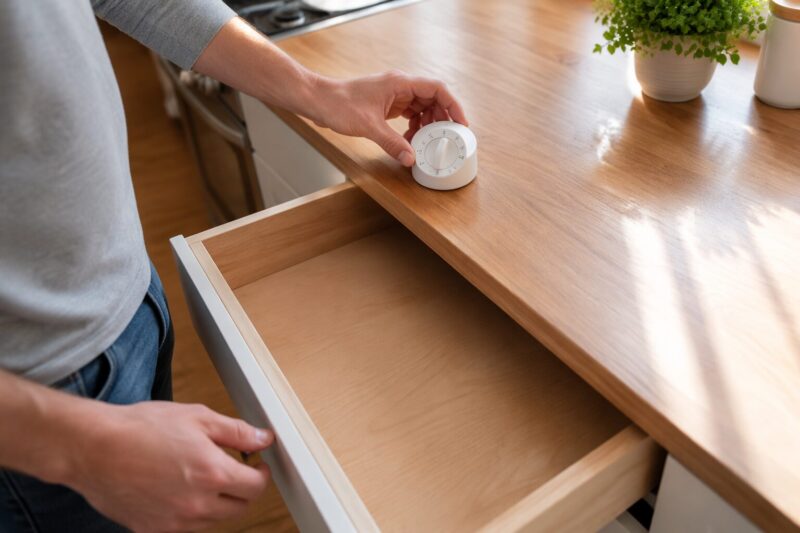
Picking a starting point that will have impact is the secret to avoiding the initial paralysis of a full-house cleanup. According to Greater Good, a research initiative from the University of California, Berkeley, you should look for one high-impact, small starting point like a single bedside table or a neglected junk drawer. Identify the intended purpose of that room before you begin to guide your decision-making. If you are struggling with larger rooms, you might find Apartment Rooms: How to Maximize Space and Functionality helpful for identifying how items should fit into your layout. Set a realistic time block, ranging anywhere from 5 to 180 minutes, and ensure you have no interruptions to finish what you started.
Step 2: The “Clear and Sort” Method
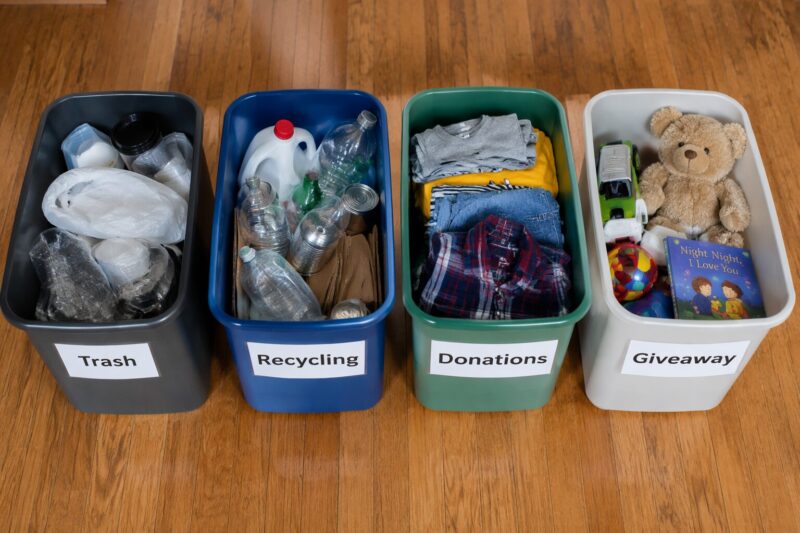
Empty the chosen space entirely into a pile or into your pre-staged bins. Zen Habits notes that putting everything into a pile forces you to confront the volume of what you actually own. Once the piles are out, categorize items based on whether you currently use them or if you have simply outgrown them. The rule is simple: if you don’t use it, you must lose it. Keep only what you truly love or what currently functions as a daily tool. Returning only essential items creates the physical space that makes a room feel peaceful.
Step 3: Implement the “Shop Your Stuff” Buffer
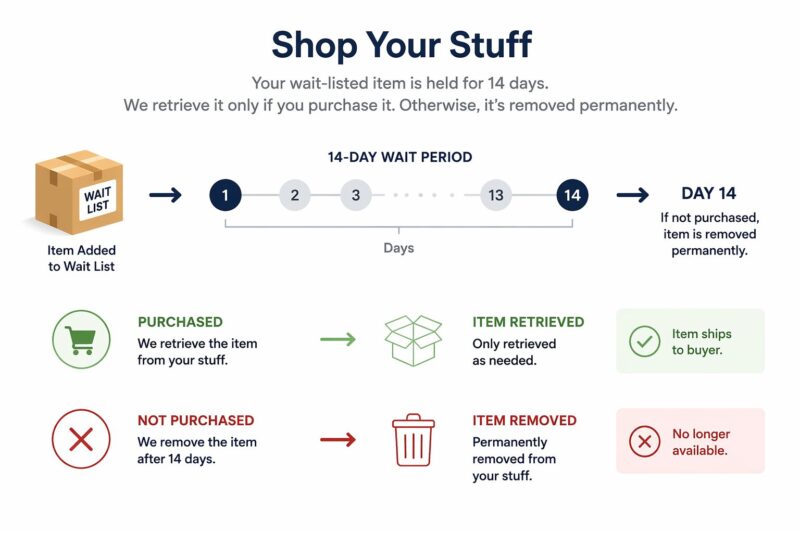
Place items you are unsure about into a “waiting” box rather than discarding them immediately. Apartment Therapy calls this the “shop your stuff” technique, allowing you to live your life and see if you actually reach for those items over the next 1 or 2 weeks. If you haven’t opened the box to retrieve an item during this period, you have concrete proof that you do not need it. Donate or dispose of whatever remains in that box once the time is up. This buffer significantly lowers the anxiety associated with getting rid of sentimental or “maybe someday” belongings.
Step 4: Create a Sustainable Maintenance Habit
Commit to small, incremental progress by aiming for a target of 10 items or just 5 minutes of work per day. Cultivate What Matters suggests that setting these bite-sized goals keeps your momentum high without draining your motivation. Use a 30-day waiting list for any new item you feel tempted to purchase to prevent re-cluttering your newly cleared spaces. Incorporating evening reflections to review what you accomplished keeps your focus on the long-term goal of a simpler home. Just like when implementing 12 Expert Preschool Classroom Ideas That Save Time, structured habits allow you to maintain order with minimal daily effort.
Mistakes to Avoid
Avoiding the “weekend marathon” trap is mandatory if you want to keep your sanity. Tidy Happy Calm warns that trying to clear an entire house in 2 days leads to exhaustion and poor decision-making when you are tired. Do not skip the step of assigning a permanent home for every item that stays, or the clutter will simply return to your surfaces by next week. Finally, do not keep “maybe someday” items if you have not used them in the last year. These items occupy valuable space and create mental weight.
Troubleshooting
Feeling overwhelmed? Stop immediately, shrink your area of focus even further, and set a shorter timer. You do not need to finish everything in one go. If you are struggling to let go of specific items, use the 2-week “shop your stuff” delay tactic to prove to your brain that you don’t rely on them. Dealing with digital clutter follows a similar logic. Use the 30-day plan found in resources like Dean Care to delete apps, unsubscribe from emails, or clean your phone photos in a single dedicated session. If your goal feels unattainable, break your master list into smaller chunks.
FAQ
Q: Why do decluttering experts say to start small?
Starting small lowers overwhelm and makes it more likely you will finish a defined space. Experts warn that planning to declutter a whole house in a weekend is usually unrealistic. A small start helps you build momentum through quick wins rather than feeling drained by a massive project.
Q: How do I decide what to keep when decluttering?
Keep items you use, love, or need, and let go of items you have outgrown or no longer use. Conduct a basic test: does the object support the room’s purpose and your current life? If the answer is no, the item is likely acting as clutter.
Q: What is a simple decluttering process for beginners?
A beginner-friendly process is to empty the space, sort everything into keep, remove, and relocate piles, and then return only original essentials. Zen Habits and Apartment Therapy suggest this staged approach works well because it creates a clear “reset” point for any area in your home.
Q: Can decluttering help with organization and habits?
Yes, it can. Research links decluttering goals to better scheduling and habits, while it also helps build personal inner resources. The practical effect is that fewer items and clearer zones make your daily routines much easier to maintain over the long term.
Q: What mistakes should I avoid when decluttering?
Avoid starting with a huge area, overfilling bags, and keeping too many items “just in case.” You should also avoid trying to finish everything at once. Making decisions about where items go is as important as the act of removing the clutter itself.
Q: How do I keep from regretting what I donate?
Apartment Therapy suggests a temporary holding period. Place items in bags or boxes, then use your space normally for 1 or 2 weeks. If you do not need anything from the pile during that time, you know the items are truly excess. This reduces regret.
Q: What result should I expect after decluttering?
Expect a more usable, calmer, and easier-to-maintain space. The goal is to have only items that support the room’s purpose or your daily needs remaining visible. You will find that decision-making becomes faster when your environment has fewer distractions.
My Experience With How to Declutter Your Entire Home the Easy Way
I used to treat decluttering as a surgical strike—go in, destroy half the house in a weekend, and end up crying over a pile of old receipts by Sunday night. It never worked. My breakthrough came when I stopped trying to be a hero and started being a librarian for my own stuff. Setting a 15-minute timer honestly changed everything. When the timer pings, I walk away, guilt-free. That tiny bit of progress adds up faster than massive weekend cleanouts because my brain doesn’t have a chance to get “decision fatigue.” My biggest expert tip? Don’t look at the shelves. Look at the trash bin. If your bin is filling up, you are winning. It turns out that clarity is not about having a perfectly curated home—it is about having a home where you can actually find your keys and sit down without clearing a chair. Most of us just need to stop “organizing” clutter and start removing the items that don’t belong here anymore. Have you ever tried the timer method for your own junk drawer?
Conclusion
Decluttering is not just about discarding items; it is a way to reclaim your focus and create a home that supports your daily life. By starting with one small, high-impact area and strictly following a “keep or lose” rule, you stop the cycle of endless tidying. Remember that consistent, minor progress beats a sporadic, exhausting marathon every single time. Use your bins, trust the “shop your stuff” buffer, and keep your goals realistic. Your space will thank you as it becomes a much easier place to live.
References
- University of California, Berkeley. (n.d.). Six Steps to Decluttering Your Life. Greater Good. https://greatergood.berkeley.edu/article/item/six_steps_to_decluttering_your_life
- Zen Habits. (n.d.). Living Simply: The Ultimate Guide to Conquering Your Clutter. Zen Habits. https://zenhabits.net/living-simply-the-ultimate-guide-to-conquering-your-clutter/
- Cultivate What Matters. (n.d.). How to Structure Decluttering and Organizing Goals. Cultivate What Matters. https://cultivatewhatmatters.com/blogs/cwm/how-to-structure-decluttering-and-organizing-goals
- Tidy Happy Calm. (n.d.). Set yourself a SMART resolution. Tidy Happy Calm. https://www.tidyhappycalm.co.uk/smart-goal-setting
- Dean Care. (n.d.). R.E.A.L. GoalSM: Declutter Your Home. Dean Care. https://www.deancare.com/getmedia/e480cfc9-4a33-42b4-9316-f2c303d26e76/dean-declutter-your-home.pdf
- Apartment Therapy. (n.d.). How to Declutter Any Space in 20 Minutes. Apartment Therapy. https://www.apartmenttherapy.com/pro-organizer-3-step-decluttering-process-37204130

A Teacher with 5 years of experience. Our Expertise, is reliable to meet your full Academic development needs . Worked on many crafts and construction projects offering services from design to development to deployment over the years. You will find many of my works in my business portfolio on request.