
Popsicle sticks are not just for crafts. They also make great tools for games, math practice, and simple science experiments that keep kids busy without a screen. This list covers 13 popsicle stick activities that mix learning with play, from color sorting for toddlers to bridge building for older kids. Each idea lists the extra supplies you need, the skills it builds, and a simple tip to make setup faster. Most of these use things you already have at home, like markers, paper, and glue, so you can start in just a few minutes. Whether you are a parent filling a rainy afternoon or a teacher planning a lesson, there is something here for every age group.
Quick Answer
The best popsicle stick activities for most kids are the color sorting game, the counting math game, and the shape building activity, since they only need markers and paint and work for toddlers through early elementary kids. For older kids, a popsicle stick bridge or catapult turns the same simple sticks into a real STEM building challenge.
| Activity | Skill Built | Best Age Group |
| Color Sorting Game | Color recognition | Toddlers |
| Counting Math Game | Number sense | Preschool, Early elementary |
| Shape Building Sticks | Shape recognition | Preschool, Early elementary |
| Sight Word Reading Game | Early literacy | Early elementary |
| Pattern Making Sticks | Logic, sequencing | Preschool, Early elementary |
| Number Order Game | Number sequencing | Early elementary |
| Name Puzzle | Letter recognition | Preschool |
| Addition and Subtraction Sticks | Basic math | Early elementary |
| Balancing Tower Challenge | Physics, motor skills | Elementary |
| Popsicle Stick Car Launcher | Force and motion | Elementary |
| Popsicle Stick Bridge | Engineering | Elementary, Middle school |
| Popsicle Stick Catapult | Physics, engineering | Elementary, Middle school |
| Grammar Sorting Cups | Grammar, language | Elementary |
Setup time (minutes, rough estimate)
1. Color Sorting Game
A color sorting game uses popsicle sticks painted in different colors, which kids then group into matching piles or containers. Paint a batch of sticks in five or six solid colors, let them dry, then give your child small cups or bowls labeled with the same colors to sort them into.
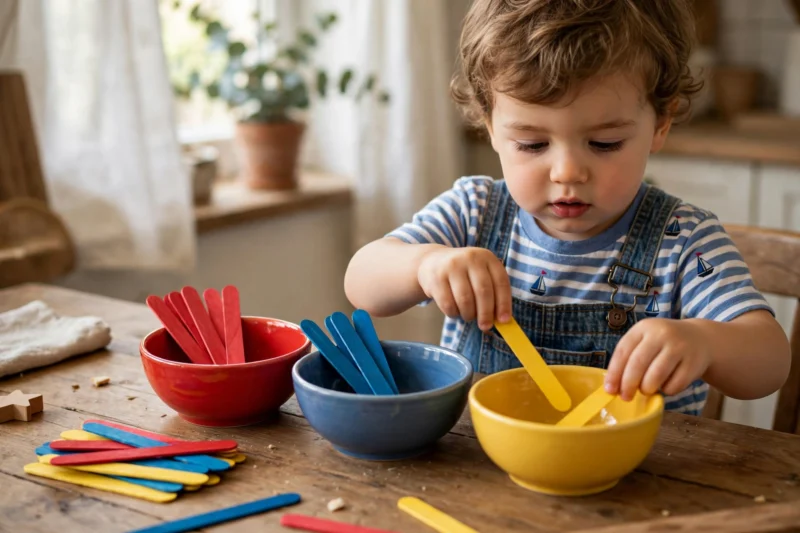
This activity works especially well for toddlers because it turns a simple color-matching task into hands-on play. A guide to popsicle stick projects lists this exact color sorting activity as a strong pick for toddlers learning colors, since the sticks are easy for small hands to grip and move.
You can extend the activity by turning it into a find-and-match game, spreading painted sticks around a room and having your child search for and match them by color. Adding simple counting questions afterward, like asking how many blue sticks they found, stretches one simple setup into two skills at once.
2. Counting Math Game
A counting math game uses numbered popsicle sticks with matching dots drawn on them, so kids can count the dots and check their answer against the number. Write a number on each stick, then draw that many dots underneath it, so a child can count the dots and confirm the number is correct.
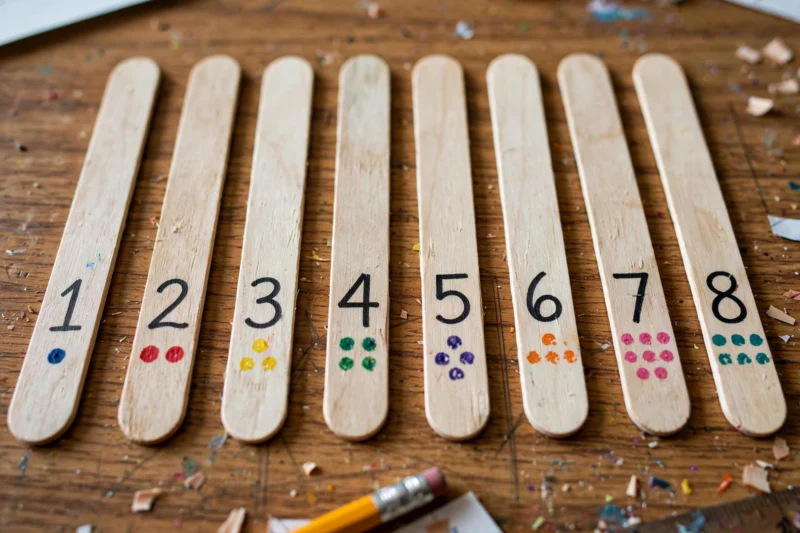
This activity is popular because it is self-checking, which means kids can practice without needing an adult to grade every answer. A craft and activity roundup describes this counting popsicle stick math game as a way to help kids count and compare numbers, and notes it can be adjusted into simple addition problems for older children.
Once your child is comfortable matching numbers to dots, mix the sticks up and have them put the full set back in order from smallest to largest. This turns one batch of sticks into both a counting activity and a number-ordering activity without making anything new.
3. Shape Building Sticks
Shape building sticks let kids arrange popsicle sticks into different shapes, so they can see and count sides as they build triangles, squares, and pentagons. Give your child a pile of loose sticks and ask them to build a specific shape, then count the sides together once it is finished.
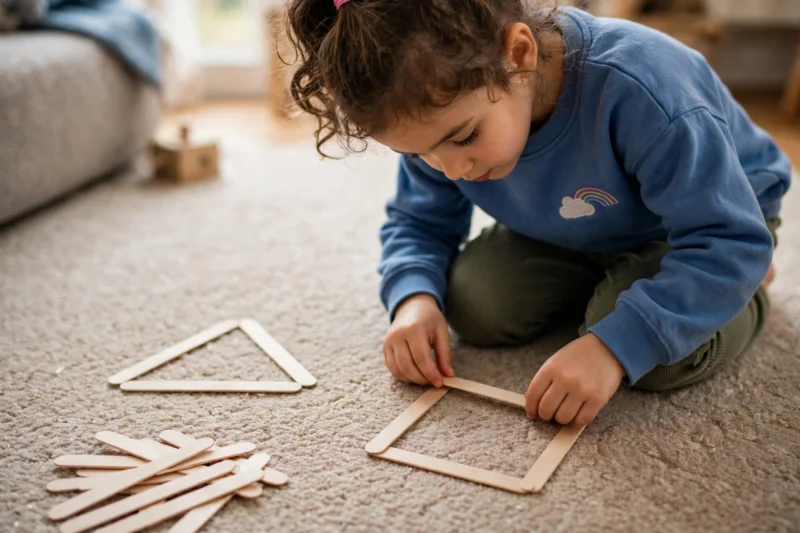
This hands-on approach makes shapes easier to understand than looking at a flat picture in a book. A popsicle stick crafts roundup for kids describes a craft stick shapes activity as simple for parents and teachers to set up, and notes kids use it to learn different shapes and how many sides each one has.
For a bigger challenge, try building 3D shapes by combining sticks with small balls of modeling clay at the corners. This turns a flat shape activity into a hands-on geometry lesson that works well for slightly older kids who already know their basic 2D shapes.
4. Sight Word Reading Game
A sight word reading game uses large popsicle sticks with one sight word written on each one, so kids can practice reading words quickly by picking sticks at random. Write one common sight word per stick using a permanent marker, place the sticks in a cup, and have your child pull one out and read it aloud.
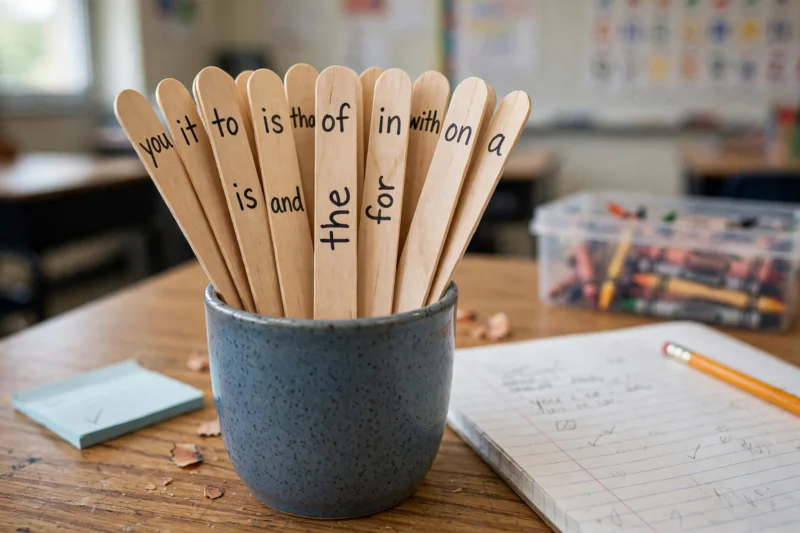
Turning word practice into a pick-and-read game keeps early readers more engaged than a plain worksheet. A popsicle stick crafts roundup describes this exact sight word game as easy to make with large sticks and a marker, and notes it tends to become a favorite among early readers.
You can raise the challenge over time by swapping in new words as your child masters the old set. Playing in teams or racing against a timer also works well for a small group or classroom setting, since it adds a bit of friendly competition to plain word practice.
5. Pattern Making Sticks
Pattern making sticks are painted in a repeating color sequence, and kids continue the pattern using extra sticks from the same set. Paint a run of sticks in a repeating order, like red, blue, red, blue, lay them out, then hand your child more sticks to keep the pattern going.
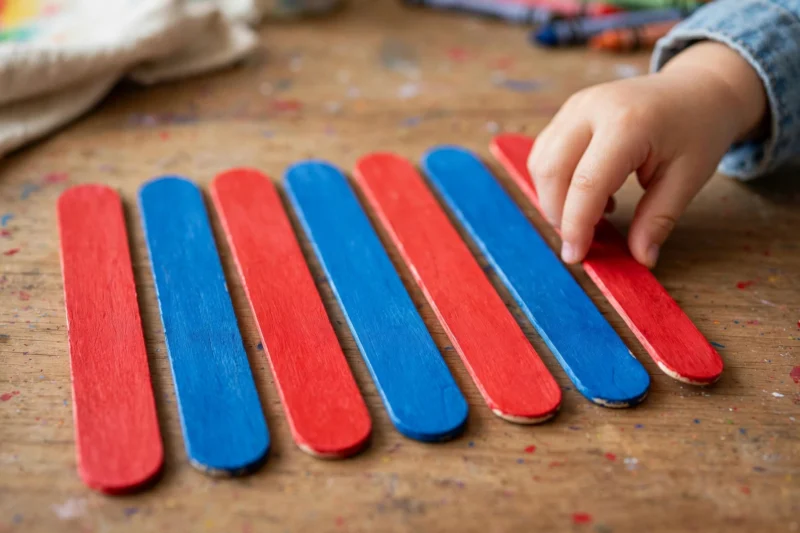
This activity builds early logic skills before kids are ready for more complex math. A popsicle stick activity guide describes pattern-making with painted sticks in sequences as a way to build logic skills, since children have to notice the repeat and predict what comes next.
Start with simple two-color patterns, then move to three or four colors once your child gets the idea. You can also swap colors for shapes or numbers on the sticks to keep the same pattern-recognition skill fresh with a new twist.
6. Number Order Game
A number order game uses popsicle sticks numbered from 1 to 20, which get mixed up and then placed back in the correct order. Write one number on each stick from 1 to 20, mix the sticks in a pile, then have your child lay them back out in order from smallest to largest.
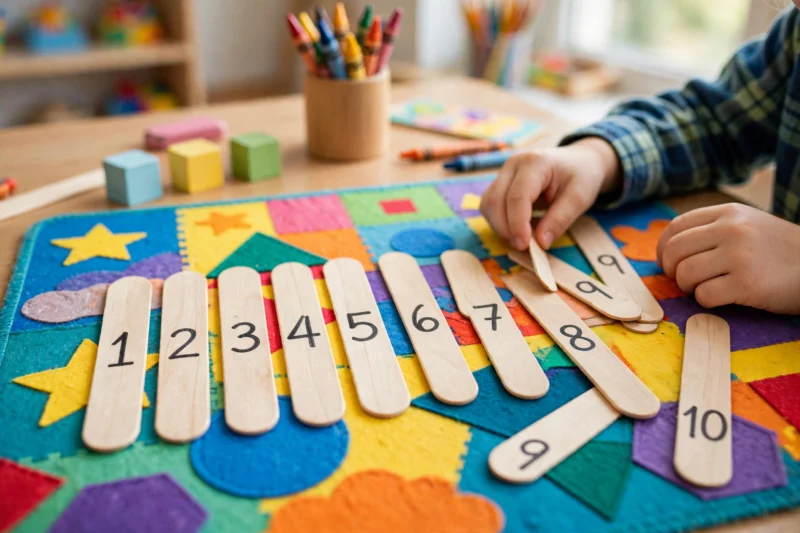
This activity reinforces number sequences in a way that feels more like a puzzle than a worksheet. A popsicle stick activity roundup describes this number order game as a way to reinforce number sequences, using sticks written from 1 to 20 that get mixed and reordered.
For younger kids, start with a smaller range like 1 to 10, and add higher numbers as they get more confident. Timing how fast your child can put the full set back in order is a fun way to track their progress over several practice sessions.
7. Name Puzzle
A name puzzle is a set of popsicle sticks with one letter of a child’s name written on each stick, which they arrange in order to spell their name. Write each letter of your child’s name on a separate stick, mix them up, then have your child put the letters back in the right order.
Because a child’s own name is one of the most motivating words for early literacy, this activity tends to hold attention longer than random letter practice. A learning activities guide for popsicle sticks describes a personalized name puzzle as a way to help preschoolers develop their literacy skills.
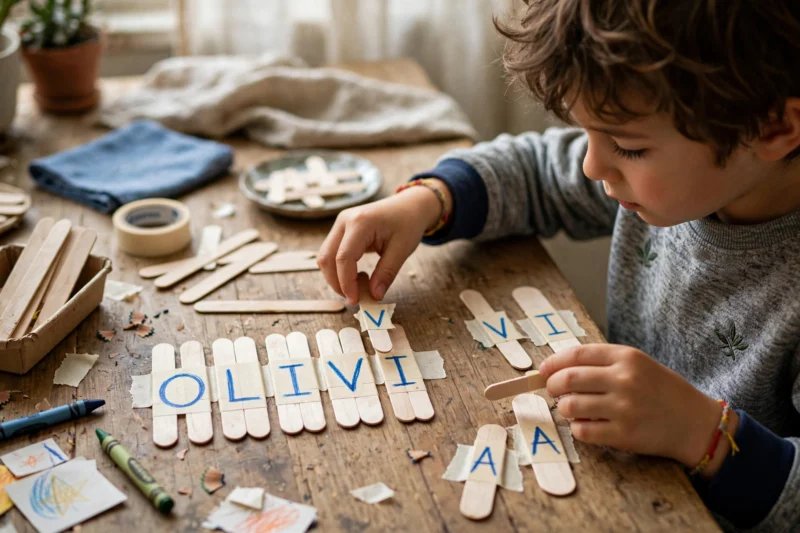
Once your child can spell their own name easily, try making puzzles for family members’ names or simple three-letter words. Drawing a small picture next to each letter also helps connect the letter sound to something familiar for very young learners.
8. Addition and Subtraction Sticks
Addition and subtraction sticks turn plain popsicle sticks into physical objects kids can move around to solve simple equations. Write a math problem on an index card, then have your child use loose sticks to act out the problem by grouping, adding, or removing sticks until they reach the answer.
Giving kids something physical to move helps make abstract math feel more concrete. A roundup of popsicle stick activities describes a hands-on activity that first graders use to get a feel for equations, using the sticks to physically practice addition and subtraction rather than just writing numbers on paper.
Bundling sticks into groups of ten with a rubber band is also a simple way to introduce place value once basic addition feels easy. This turns the same set of sticks into a tool for a slightly more advanced math concept without buying anything new.
9. Balancing Tower Challenge
A balancing tower challenge asks kids to stack popsicle sticks on a wobbly platform without letting the tower tip over. Set up a small unstable base, like a ball or a rolled-up piece of clay, then have your child carefully add sticks one at a time to build the tallest stable tower they can.
This activity turns basic physics into a game kids want to keep replaying. A craft and activity roundup describes this homemade balancing activity as a fun way to explore physics, and notes it was a hit with kids as a rainy day activity that uses very simple setup.
Try timing how long a tower stays standing, or compare which stacking pattern holds the most weight before falling. Talking through why a wider base is more stable than a narrow one adds a short science lesson to what already feels like a fun challenge.
10. Popsicle Stick Car Launcher
A popsicle stick car launcher is a simple lever built from stacked sticks and rubber bands that flings a small toy car forward when pressed down and released. Stack several sticks together, wrap rubber bands around one end to create tension, then press down on the free end and let go to launch a small toy car.
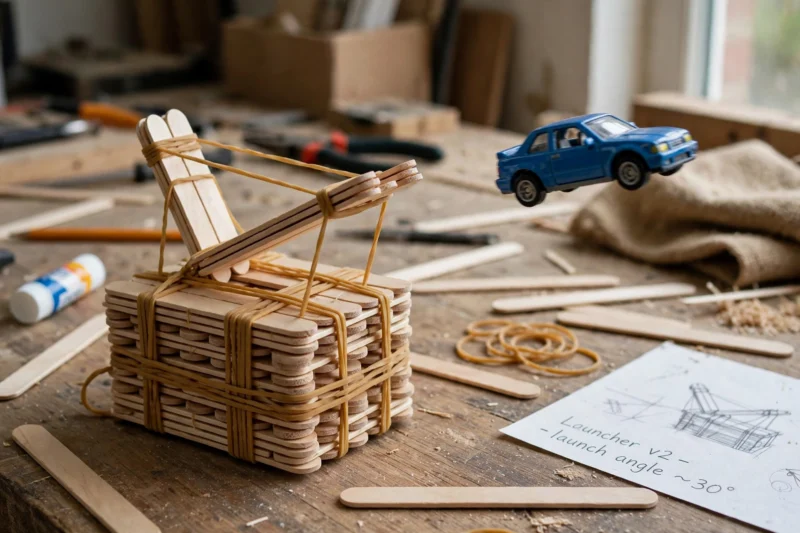
This build lets kids explore force and motion in a way that feels like play instead of a lesson. A STEM activities guide describes the car launcher as a way for kids to explore force and motion while having fun, and suggests measuring how far the car travels each time to turn it into a mini science investigation.
Once the basic launcher works, challenge your child to test different variables, like changing the number of sticks or the number of rubber bands, and figure out which change makes the biggest difference in distance. This is a fast STEM activity kids can start almost immediately with materials most homes already have.
11. Popsicle Stick Bridge
A popsicle stick bridge is a small engineering project where kids glue sticks together into a structure that can hold weight while spanning a gap. Set a rule, like using only 20 sticks, and challenge your child to build a bridge that can stand on its own between two supports.
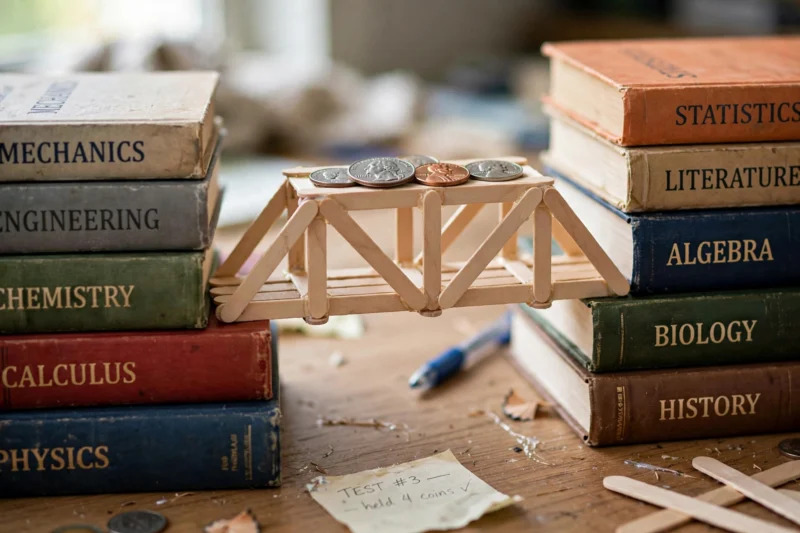
This is one of the more advanced builds on this list because kids have to think about how each piece supports the others. A STEM activities guide suggests giving kids a rule like using only 20 sticks and requiring the tower or bridge to stand on its own, then encouraging them to compare their build with pictures of real bridges afterward.
Once the bridge is built, test how much weight it can hold using small objects like coins or blocks. Asking your child what they would change on a second attempt turns one build into a full engineering exercise instead of a single try.
12. Popsicle Stick Catapult
A popsicle stick catapult is a small launching device built from layered sticks and a rubber band, made to fling small objects like pom-poms or mini marshmallows. Stack several sticks and secure them with rubber bands to build a lever arm, add a small cup or bottle cap at the end to hold the object, then press and release to launch.
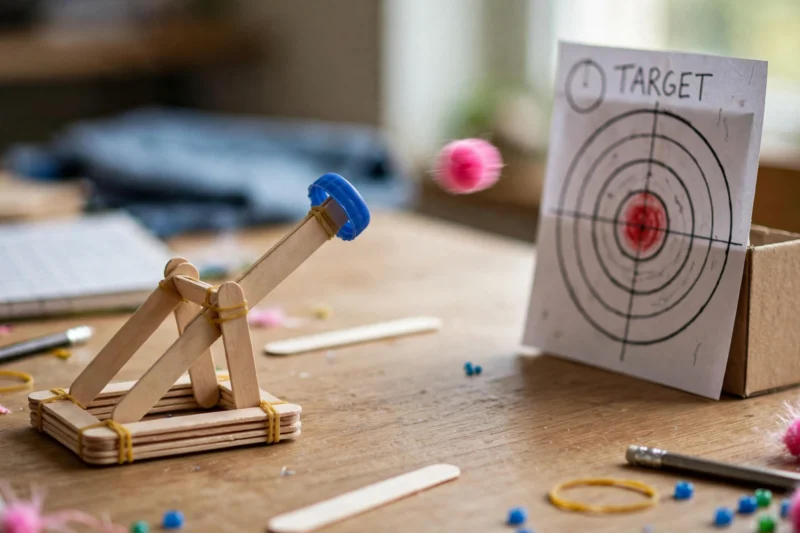
This activity is a hands-on way to explore basic physics concepts like force and leverage. A STEM activities guide for kids notes that a handful of popsicle sticks can become a catapult, marble run, gear system, or something else entirely, and encourages letting kids figure out the design through trial and error.
Set up a simple target and have kids measure how far or accurately they can launch their object. Comparing catapult designs between kids or teams adds a friendly competitive element that keeps the activity going well past the first launch.
13. Grammar Sorting Cups
Grammar sorting cups pair popsicle sticks with labeled cups, so kids sort words written on sticks into the correct part of speech. Write a mix of nouns, verbs, and adjectives on separate sticks, label three cups with those categories, then have your child sort each stick into the matching cup.
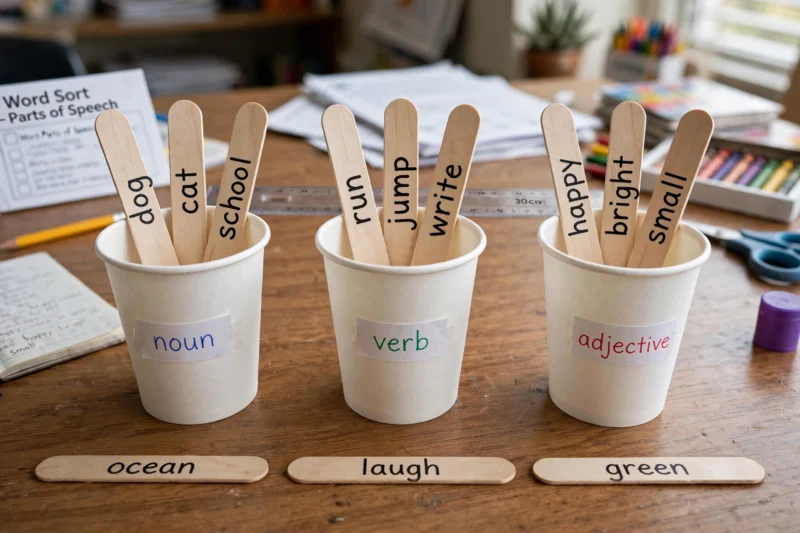
This activity makes grammar concepts easier to grasp because kids are physically sorting instead of just reading definitions. A learning activities guide describes this exact craft stick and cup activity as a way to bring grammar to life, letting kids sort and classify different parts of speech in a tactile way.
Start with just two categories, like nouns and verbs, before adding a third once your child feels confident. This activity also works well in a small group setting, where kids can take turns sorting and checking each other’s answers.
How do you set up a popsicle stick activity step by step?
You set up a popsicle stick activity by choosing a skill to focus on, prepping the sticks ahead of time, and giving clear instructions before letting kids play. Here is the basic order that works for almost any activity on this list.
- Pick the skill you want to practice, like counting, colors, letters, or basic physics.
- Gather clean sticks along with markers, paint, or labels needed for that specific activity.
- Prep the sticks ahead of time, writing numbers, letters, or words, or painting colors and patterns.
- Let everything dry fully if you used paint, so the activity does not smear during play.
- Explain the rules simply before handing the sticks over, so kids know the goal of the activity.
- Let kids try the activity with minimal help first, stepping in only if they get stuck.
- Add a follow-up question or challenge, like counting results or trying a harder version, to stretch the learning further.
FAQ
What age group are popsicle stick activities best for?
Popsicle stick activities work for almost every age, from toddlers doing simple color sorting to middle schoolers building bridges and catapults. The activity itself, not the sticks, is what determines the right age group.
Do popsicle stick activities need special supplies?
Most of these activities only need popsicle sticks, markers or paint, and a few household items like cups, rubber bands, or paper. None of the activities on this list need anything you cannot find at a regular grocery or craft store.
Can popsicle stick activities be reused?
Yes, most of these activities can be reused many times, especially sorting games, number games, and letter puzzles. Building activities like the bridge or catapult are usually one-time builds, but the sticks can be pulled apart and reused for a fresh build later.
How many popsicle sticks do I need for these activities?
Most sorting, counting, and letter activities only need 10 to 20 sticks. Building activities like the bridge or catapult usually need 20 to 50 sticks, depending on how big or sturdy you want the final structure to be.
Are popsicle stick STEM activities good for classrooms?
Yes, popsicle stick STEM activities work well in classrooms because they are cheap, low mess, and easy to do in small groups. Bridge and catapult challenges especially work well as team activities, since kids can compare designs and talk through what worked and what did not.
References
- The Secret Life of Homeschoolers, “14 STEM Activities with Popsicle Sticks for Kids” (2026)
- How Wee Learn, “Popsicle Stick Crafts: 35 Fun Things for Kids to Make & Do” (2025)
- TheMasterCraft, “53 Popsicle Stick Crafts for Kids: Easy & Fun Ideas” (2026)
- ArtsyCraftsyDad, “Popsicle Sticks Learning Activities for Kids” (2026)
- PreschoolToolkit.com, “Fun Things For Kids to Do With Popsicle Sticks” (2026)
- Happy Toddler Playtime, “Popsicle Stick Match Activity for Toddlers” (2026)

A Teacher with 5 years of experience. Our Expertise, is reliable to meet your full Academic development needs . Worked on many crafts and construction projects offering services from design to development to deployment over the years. You will find many of my works in my business portfolio on request.