10 Practical Art Journal Therapy Ideas to Reduce Stress
Art journal therapy ideas help you reduce stress through creative expression. Discover 10 practical techniques like breath drawing, mood collages, and mand
Want to turn your emotions into art without needing any drawing skill? Art journal therapy offers a direct way to process feelings, calm your mind, and build a daily self-care habit that costs almost nothing to start. Whether you’re looking to reduce stress, work through difficult emotions, or simply find a creative outlet that feels less intimidating than a blank canvas, these ten techniques give you concrete starting points. Each one is designed for beginners, requires minimal supplies, and focuses on expression over perfection. Let’s explore the methods that actually work.
Quick Questions and Answers
Question: What are easy art journal therapy ideas for beginners?
Easy beginner ideas include mood collage, writing and drawing how you feel, gratitude pages, doodle diaries, and theme-based sketchbook pages. Several sources also recommend breath-based drawing, watercolor doodling, and simple daily record pages because they reduce pressure and help you start with a small, repeatable practice.
Question: How does art journaling help with stress?
Art journaling can help with stress by giving you a structured way to externalize emotions through color, shape, images, and words instead of trying to explain everything verbally. The practice works as a self-care or relaxation tool, especially through prompts like feelings journals, mood boards, gratitude pages, and meditative drawing exercises.
Question: Can art journal therapy be done without drawing skill?
Yes. Multiple methods emphasize collage, writing, photo-based pages, doodling, and mixed-media approaches, which do not require strong drawing ability. The practice is meant to be flexible rather than skill-gated, so you can start right now with whatever materials you have on hand.
Key Takeaways
Art journal therapy works best when you prioritize emotional release over technical perfection.
Structured prompts and bounded spaces (like mandalas or circles) help beginners feel less overwhelmed by blank pages.
Repetitive, rhythmic techniques like breath drawing or doodling activate the nervous system’s calming response.
Low-cost, found materials like magazine scraps and old book pages remove barriers to starting.
The most effective practice is whatever you’ll actually do consistently, even if it’s just five minutes a day.
1. Breath Meditation Drawing
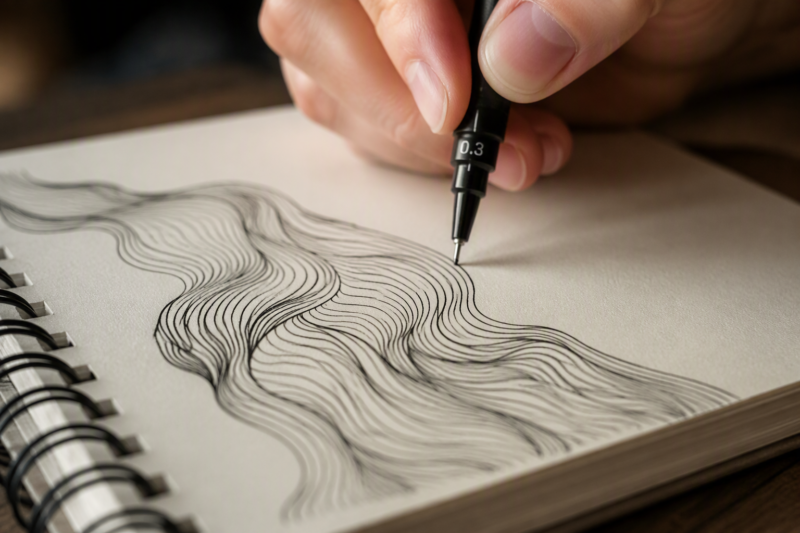
Synchronizing your pen strokes with your breathing creates an anchor for the nervous system. As you inhale, you draw a line upward or outward. As you exhale, you complete the stroke or add a new element. The rhythm becomes meditative almost immediately, and there’s no “wrong” way to do it.
This technique works because the repetition and pace naturally calm your body. You’re not trying to create something representational or beautiful—you’re simply marking the page in time with your breath. A lot of people find this helpful on mornings when they wake up anxious or evenings when stress has built up through the day. According to Mindful Creative Muse’s beginner guide to art journaling, the breath meditation exercise is specifically listed as a foundational grounding technique that helps beginners feel less intimidated by the blank page.
All you need is a pen or fine-liner and a sketchbook page. Spend five to ten minutes on this alone, or use it as a warm-up before moving to other journal exercises. The physical act of slowing down your hand speed naturally slows your thinking.
2. Monochromatic Color Exploration
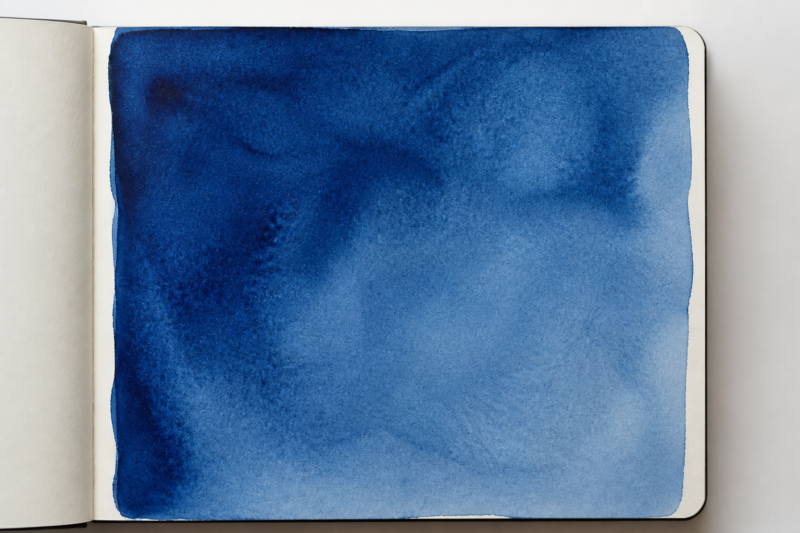
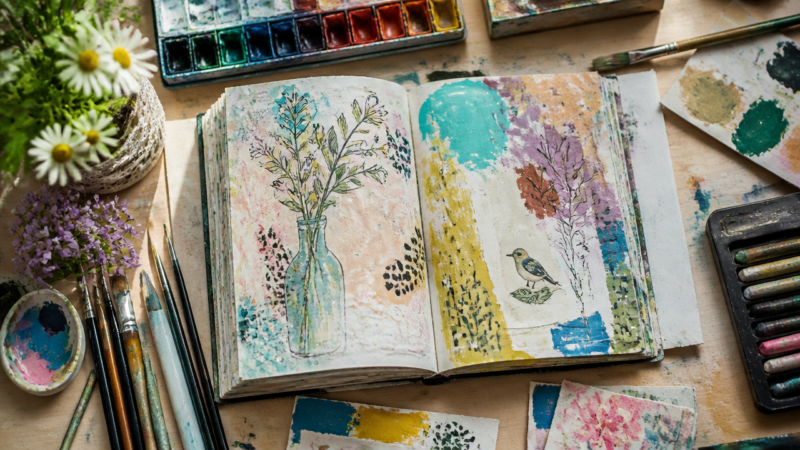
Pick one color that matches how you feel right now. Then spend the page exploring it—different shades, textures, marks, patterns. A single color removes decision fatigue and forces you to focus on depth instead of variety.
This technique works especially well when emotions feel too tangled to name. Instead of asking “What am I feeling?”—a question that can feel paralyzing—you ask “If my feelings today were a single color, what would they be?” The answer often comes faster and feels more honest. Erin Condren’s inspiration center recommends starting with a prompt like “Create a Page Inspired by Your Favorite Color” precisely because the simplicity removes the pressure to create “perfect” multi-colored art.
You can use markers, colored pencils, watercolors, or even crayons. Build layers, leave white space, or fill the entire page. The point is to go deeper into one emotional truth rather than skimming across many. This is also a great stepping stone for watercolor craft ideas for beginners if you want to explore beyond pen and paper.
3. Sentiment-Filled Memory Boxes
Step beyond the journal page and decorate a small box—a shoebox, a wooden box, or even a decorated envelope. Fill it with objects that hold meaning: ticket stubs, dried flowers, handwritten notes, photos, small stones. This moves art therapy into three dimensions.
Memory boxes work because they’re tactile and honorable. You’re not just writing about or sketching a memory; you’re physically gathering objects that represent it. Rocky Mountain College of Art + Design includes Memory Boxes as one of their core art therapy activities, describing them as tools for processing past events or honoring personal milestones. The act of decorating the container itself becomes part of the reflection—you get to choose colors, textures, and embellishments that feel true to what you’re preserving.
This approach is especially powerful for grief work, celebrating anniversaries, or holding space for a particular chapter of your life. Unlike a journal entry that you might not look at again, a memory box becomes something you return to and add to over time.
4. Non-Dominant Hand Sketching
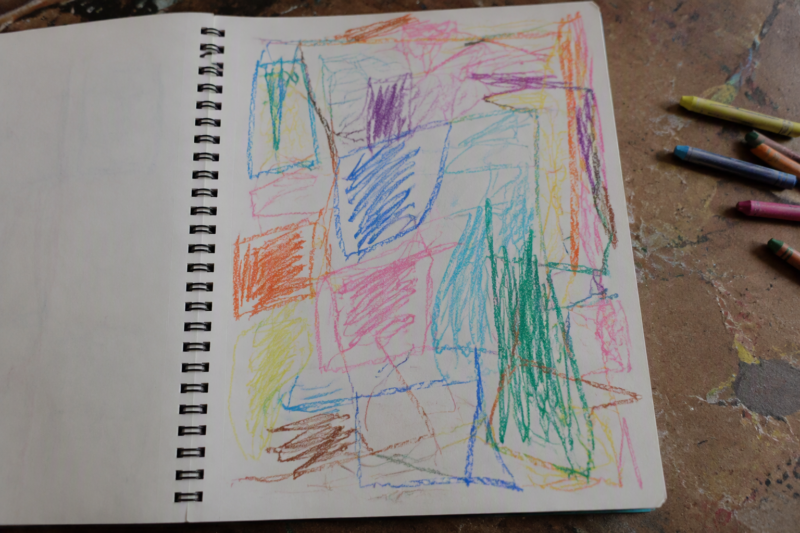
Use your non-dominant hand—the left if you’re right-handed, the right if you’re left-handed. The clumsiness is the whole point. By forcing your brain to relinquish control, you bypass the part of you that judges every line.
What emerges is almost always raw and honest. The marks are shaky, the proportions are off, and none of it “looks right.” That’s exactly why it works. Your inner critic—the voice that usually runs the show—can’t engage because your hand is too busy trying to figure out basic motor control. Psychology Today’s visual journaling prompts specifically highlight this technique as a warm-up activity to break through creative blocks or frustration.
Try sketching your face, your hands, or an emotion as an abstract shape. Spend five minutes without looking away or trying to “fix” anything. Most people find this exercise liberating. You’re not making art; you’re releasing control, which is often the opposite of what stress teaches us to do.
5. Emotion-Based Mood Collages
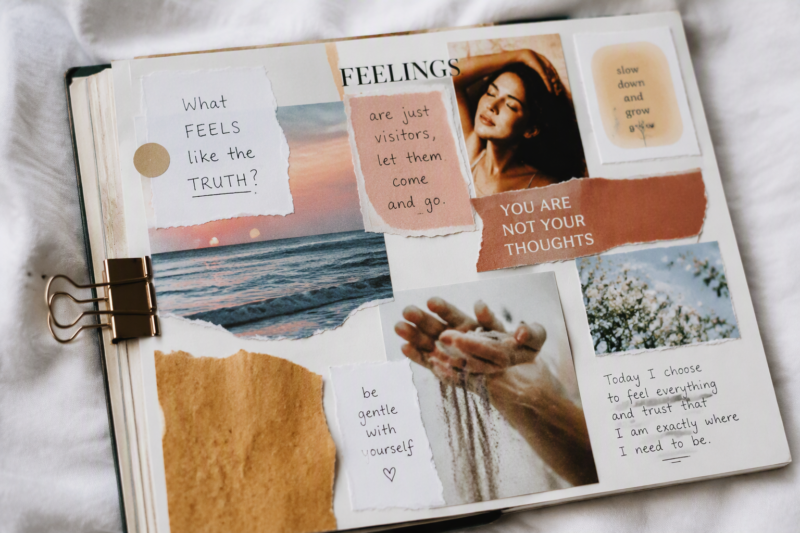
Gather magazines, printed images, or any visual material you have. Choose an emotion you’re sitting with—anxiety, joy, grief, confusion, hope. Flip through the images and cut out anything that resonates, without overthinking. Then glue these pieces onto a journal page and write about why each one matters.
Collage works because you’re not inventing the imagery from scratch. You’re selecting and arranging, which feels less demanding. The emotional work happens in the choosing and the writing, not in trying to draw something perfect. Drawism’s collage example asks you to pick an emotion, gather images that represent it, and then write why you feel that way on the page—creating a hybrid of visual journaling and reflective writing.
This technique is especially helpful if words alone feel stuck. Sometimes seeing an image move you emotionally opens a door that blank paper can’t. Over time, your collage pages become a visual diary of your emotional landscape—a concrete record of what mattered to you week by week.
6. Structured Mandala Creation
A mandala is a bounded, circular shape that you fill with patterns, colors, or designs. It can be as simple as concentric circles with doodles or as intricate as you want. The circular boundary is the real magic—it contains your work and makes a large blank page feel less overwhelming.
Mandalas invoke calm through repetition and symmetry. There’s no narrative pressure, no “story” to tell. You’re simply filling space with repetitive marks that gradually build into a whole. Psychology Today includes mandala journaling as one of their core visual journaling prompts, noting that it offers a contained format that is less overwhelming than large, open-ended landscape pages. For people with anxiety, the bounded space and the meditative rhythm of creating symmetric patterns can feel genuinely grounding.
You can use a compass to draw the circles or just draw them freehand. Fill them with zentangles, mandalas, or abstract patterns. The imperfection is part of what makes it feel honest and personal.
Technique
Best For
Time to Complete
Materials Needed
Skill Level
Breath Meditation Drawing
Calming anxiety, grounding
5–10 minutes
Pen, paper
Complete beginner
Monochromatic Color Exploration
Processing unnamed emotions
10–15 minutes
Colored pencils, markers, or paint
Complete beginner
Memory Boxes
Honoring milestones, grief work
20–30 minutes
Box, decorative items, glue
Complete beginner
Non-Dominant Hand Sketching
Breaking perfectionism, creative blocks
5–10 minutes
Pen, paper
Complete beginner
Emotion-Based Mood Collages
Visual expression of complex feelings
15–20 minutes
Magazines, glue, scissors, paper
Complete beginner
Structured Mandala Creation
Reducing anxiety through rhythm
15–30 minutes
Pen, colored pencils, compass (optional)
Complete beginner
Curated Bits and Pieces Scraps
Building daily practice habits
10–15 minutes
Found paper, glue, sketchbook
Complete beginner
Inner and Outer Self Masks
Exploring identity and hidden emotions
20–30 minutes
Cardboard, paint, markers
Complete beginner
Weather-Metaphor Doodle Diary
Tracking mood patterns
5 minutes daily
Pen, sketchbook
Complete beginner
Found-Page Altered Books
Moving past white-page fear
15–20 minutes
Old book, paint, markers, glue
Complete beginner
7. Curated Bits and Pieces Scraps
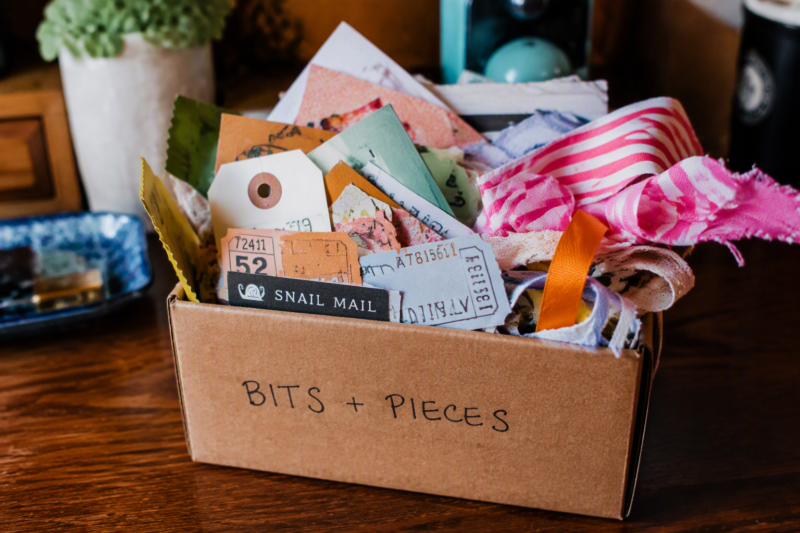
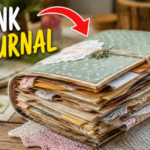
Keep a box or envelope for paper scraps—ticket stubs, fabric snippets, old postcards, envelopes, newspaper clippings, colored paper leftovers. Over time you build a personal library of textures and colors. When you journal, you reach into this box instead of starting from nothing.
This removes the pressure of needing “perfect” materials. You’re repurposing everyday items that already have history. According to TinkerLab’s article on art journal exercises, collecting scraps in a “Bits and Pieces” box for future collage work builds a personal library that makes daily journaling fast and accessible. The act of gathering materials also becomes part of the ritual—you’re actively hunting for visual inspiration rather than waiting for it to appear.
Many people find this habit-building approach more sustainable than trying to do elaborate art every single time. When collaging becomes as simple as reaching for a scrap and gluing it down, you’re much more likely to actually do it on a Tuesday morning before work.
8. Inner and Outer Self Masks
Create two masks—one representing how you appear to the world, one representing your inner reality. Use cardboard, paper plates, or even just draw them on a page. Decorate them with colors, patterns, and images that feel true to each side.
Mask-making gives you permission to acknowledge the gap between your public self and your private self—a gap that often creates stress on its own. By externalizing this split onto a physical object, you’re saying: “It’s okay that these are different. I can hold both.” According to RMCAD’s roundup of art therapy activities, mask-making allows for the safe expression of hidden emotions by projecting them onto a third-party object.
You might choose different colors, materials, or moods for each mask. The outer mask might be polished or cheerful. The inner mask might be raw, messy, or shadowy. Neither is “right”—they’re just true. Many people find that creating these masks opens conversations with themselves about what they’re actually feeling versus what they’re performing.
9. Weather-Metaphor Doodle Diary
Each day, draw a small weather icon or pattern that represents your mood. A thunderstorm for anger. Sunshine for joy. Rain for sadness. A tornado for chaos. Over time you create a visual mood tracker that’s easy to scan and reveals patterns you might not otherwise notice.
This technique transforms abstract psychological states into simplified, easy-to-draw icons that you can create in literally one minute. According to Psychology Today’s visual journaling prompts, doodle diaries use daily low-stress sketching to record moods as weather patterns, effectively turning abstract internal experiences into concrete visual metaphors. The beauty of this method is that it works even on days when you don’t feel like writing.
After a month, you’ll see your mood patterns. Maybe you notice that Thursdays are always stormy, or that certain seasons bring consistent rain. Seeing your emotional weather mapped out over time often reveals cycles you can plan for or respond to differently.
10. Found-Page Altered Books
Take an old book you don’t want anymore and paint, collage, or draw over its pages. Write new text on top of old words. Add images. Use markers, watercolors, or collage materials. The existing text or images become part of your art instead of an obstacle.
Altered books remove the psychological weight of the blank page. There’s already something there, so you’re not starting from nothing. You’re adding, responding, transforming. Psychology Today lists altered books as one of their core visual journaling prompts, noting that this approach removes the “white page syndrome” by providing an existing structure or backdrop to build upon. For people who feel paralyzed by completely open-ended creative work, this constraint is often exactly what’s needed.
The found text often creates unexpected meaning when combined with your own imagery. A random sentence from a novel becomes a prompt or a mirror. You’re in dialogue with something that already exists, which can feel less lonely than creating entirely from scratch.
Common Mistakes
The biggest mistake is treating this like you’re supposed to make something beautiful. You’re not. You’re processing. If every page looks polished and perfect, you’re probably in your head rather than in your heart.
Another common trap is waiting for the “right supplies.” You don’t need special art journal paper or professional markers. A regular notebook and a ballpoint pen work fine. Using what you already have removes the barrier to starting today instead of next month when you’ve bought the “right” materials.
Don’t compare your pages to anyone else’s. Art journal therapy is private work. It’s meant to be raw, honest, and entirely yours. Some of the most powerful pages look messy or confusing to an outsider, and that’s perfect.
Starting but never returning is also common. Pick one technique that feels easiest and commit to five minutes daily for two weeks. Consistency matters more than duration. Five minutes every day beats one elaborate hour-long session every few months.
FAQ
Q: What should I put in an art therapy journal page?
You can put feelings, colors, shapes, magazine cutouts, photos, meaningful words, gratitude notes, or simple sketches. Common prompts include how you feel today, what you are grateful for, what you feel stuck on, and what represents your current stress or strengths. There’s no fixed formula—the page is yours to fill however makes sense in the moment.
Q: Which art journal prompts are best for anxiety?
Prompts that focus on grounding and reflection work well, such as breath meditation drawings, doodle diaries, gratitude pages, and mandala-style circles. These options are effective because they are repetitive, structured, and easy to start when you feel overwhelmed. The repetition itself becomes part of the calming mechanism.
Q: Why use collage in art journal therapy?
Collage lets you build a page from found materials instead of having to invent every image yourself. Mood collages, photocollage journals, and repurposed paper exercises are accessible ways to express emotion, make memory-based pages, and reuse scraps or ephemera. You’re selecting rather than creating from nothing, which often feels less intimidating.
Q: Are art journal prompts better than free art making?
Prompts are often better for beginners or for days when you feel stuck because they give you a clear starting point. Free art making can still be valuable, and Psychology Today explicitly recommends creating your own approach when you want maximum freedom. Use prompts when you need structure, and free-form pages when you’re ready to explore without guardrails.
Q: What art journal ideas work for self-reflection?
Self-reflection works well with prompts such as values pages, strength pages, self-portraits, inner child exercises, and “How do you feel today?” journals. These ideas are designed to help you notice patterns in emotion, identity, and personal meaning rather than just make decorative art. Over time they build a personal record of who you are and what matters to you.
Q: How often should I do art journal therapy?
There is no single required schedule, but regular repetition through daily record pages, morning dream journaling, or ongoing feelings journals is often most effective. A short, consistent routine is easier to sustain than waiting for a long session of free time. Even five minutes daily compounds into real emotional relief over weeks.
Q: What materials are best for art journal therapy?
The best materials are the ones that make it easy to begin: pens, markers, colored pencils, magazines, glue, photos, watercolor, and scraps of paper. Nontraditional materials like old books, paper ephemera, and collected objects can make pages more personal and lower the cost of getting started. You likely have most of what you need already.
My Experience With 10 Practical Art Journal Therapy Ideas to Reduce Stress
I’ve watched people go from “I can’t draw” to actually looking forward to five minutes alone with their sketchbook. The shift isn’t about suddenly having talent—it’s about permission. Permission to be messy. Permission to feel something and put it on paper without editing.
Breath drawing converted me. I was skeptical about the meditation angle until I actually did it, and the calmness was immediate and weird. My nervous system just… calmed down. Like my brain didn’t know I was tricking it into being present.
The mistake I see most often is people treating their first pages like they need to be gallery-ready. They’re not. Some of the most powerful pages look like chaos to anyone but the person who made them. That’s the whole point. The pages that mattered most to me looked rough and urgent and completely honest.
What surprised me is how much the structure helps. You’d think giving yourself more rules (use only one color, stay in a circle, use only your left hand) would feel limiting. Instead it’s freeing. The boundary becomes the permission. You stop wondering “What do I do?” and start actually processing.
One thing that actually matters: consistency beats intensity. Fifteen minutes of elaborate collage once a month won’t touch you the way five minutes of doodling every other day will. The repetition builds a groove in your nervous system.
Which of these techniques feels like it might actually stick with you?
Common Mistakes
The biggest mistake is treating this like you’re supposed to make something beautiful. You’re not. You’re processing. If every page looks polished and perfect, you’re probably in your head rather than in your heart.
Another common trap is waiting for the “right supplies.” You don’t need special art journal paper or professional markers. A regular notebook and a ballpoint pen work fine. Using what you already have removes the barrier to starting today instead of next month when you’ve bought the “right” materials.
Don’t compare your pages to anyone else’s. Art journal therapy is private work. It’s meant to be raw, honest, and entirely yours. Some of the most powerful pages look messy or confusing to an outsider, and that’s perfect.
Starting but never returning is also common. Pick one technique that feels easiest and commit to five minutes daily for two weeks. Consistency matters more than duration. Five minutes every day beats one elaborate hour-long session every few months.
Conclusion
Art journal therapy isn’t about creating something worth showing anyone else. It’s about creating a safe space where your thoughts and feelings can live on paper without judgment. You don’t need skill, expensive supplies, or perfect conditions. You need five minutes, a pen, and permission to be messy.
The technique that works best is the one you’ll actually do. Start there. If breath drawing resonates, do that. If collage feels more natural, gather some magazines. The practice evolves as your needs change, and that’s exactly how it should work.
The goal is simple: feel what you’re feeling, put it on the page, and move through your day a little lighter. Everything else is just technique. You already have what you need to start.
References
Self Art Therapy. (2020, December 7). 15 Easy Mindful Art Journaling Ideas for Beginners. https://mindfulcreativemuse.com/blog/2020/12/7/15-easy-mindful-art-journaling-ideas-for-beginners
Erin Condren. (n.d.). 30 Art Journal Prompts for Relaxation and Creativity. https://www.erincondren.com/inspiration-center-art-journal-prompts
Rocky Mountain College of Art + Design. (n.d.). Brushing Away Stress: 21 Art Therapy Activities for Self-Expression and Healing. https://www.rmcad.edu/blog/brushing-away-stress-21-art-therapy-activities-for-self-expression-and-healing/
Psychology Today. (2013, November). Top Ten Art Therapy Visual Journaling Prompts. https://www.psychologytoday.com/us/blog/arts-and-health/201311/top-ten-art-therapy-visual-journaling-prompts
TinkerLab. (n.d.). Art Journal Exercises for Self-care and Creativity. https://tinkerlab.com/art-journal-exercises/
UpJourney. (n.d.). Art Therapy Journal Prompts. https://upjourney.com/art-therapy-journal-prompts
Positive Psychology. (n.d.). Expressive Arts Therapy: 15 Creative Activities and Techniques. https://positivepsychology.com/expressive-arts-therapy/
Drawism. (n.d.). Easy Art Journal Therapy for Beginners. https://drawism.com/art-journal-therapy-for-beginners/
A Teacher with 5 years of experience. Our Expertise, is reliable to meet your full Academic development needs . Worked on many crafts and construction projects offering services from design to development to deployment over the years. You will find many of my works in my business portfolio on request.