

What makes a decluttering idea stick long after the last box leaves your house? Most people try a single method, get overwhelmed, and give up. The truth is that effective decluttering ideas work best when they match your personality, your space, and your daily habits. Whether you’re tackling a spring reset or a move to a smaller apartment, the right approach makes all the difference. I’ve tested and researched the most reliable methods so you can skip the trial and error.
Quick Questions and Answers
Question: What are the easiest decluttering ideas for beginners? Answer: The easiest ideas start small—one drawer, one shelf, or one category of items. Multiple sources recommend beginning with low-emotion objects like old magazines or mismatched Tupperware, then using simple sort buckets: keep, donate, sell, and trash. This makes decisions fast and visible.
Question: How do you declutter a house without getting overwhelmed? Answer: Work one small area at a time and set a fixed end point. Sources suggest giving yourself a limited window—3 to 4 hours for a major room reset or 10 minutes a day for papers—so the task stays manageable. Breaking the house into zones prevents the paralysis that comes from staring at the whole problem.
Question: Can decluttering ideas help with a cluttered closet? Answer: Yes. Closet-focused advice includes starting with the oldest items, reviewing clothing critically, and sorting by category rather than by room. Clothing is easy to batch-process and usually has clear keep-versus-donate decisions, making this a good entry point for beginners.
Key Takeaways
- Use a sorting system (boxes, bags, or piles) to avoid decision fatigue.
- Start with low-emotion items to build momentum.
- Set a time limit to prevent burnout.
- Remove sorted items from your home immediately to stop backsliding.
1. The Four-Box Method
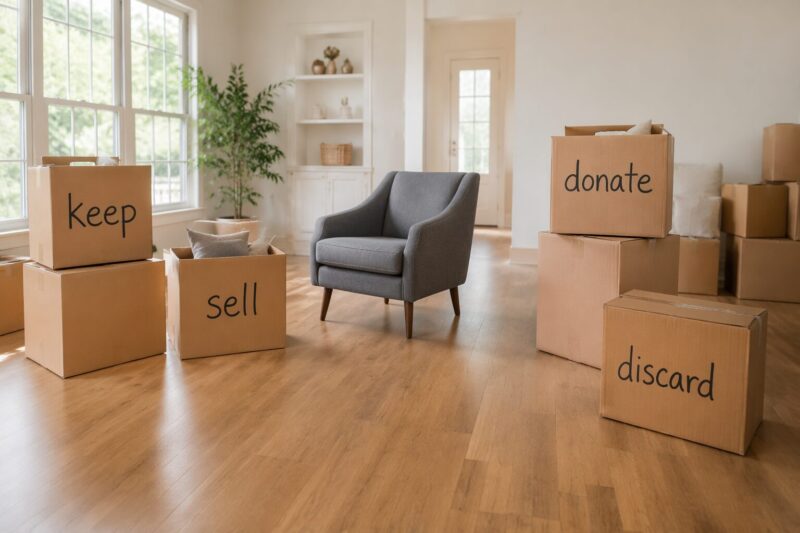
This is the most straightforward decluttering idea I know. Take four boxes or bins and label them “keep,” “sell,” “donate,” and “trash.” Every item you pick goes into one of these boxes. No maybes, no “I’ll decide later.” According to a guide from KEEPER, this method forces immediate decisions and prevents objects from migrating back into the pile.[1] It works best in high-clutter areas like a spare bedroom or a garage. The key is to close the keep box once it’s full and commit to removing the other boxes from your house within a week.
2. The Ski Slope Technique
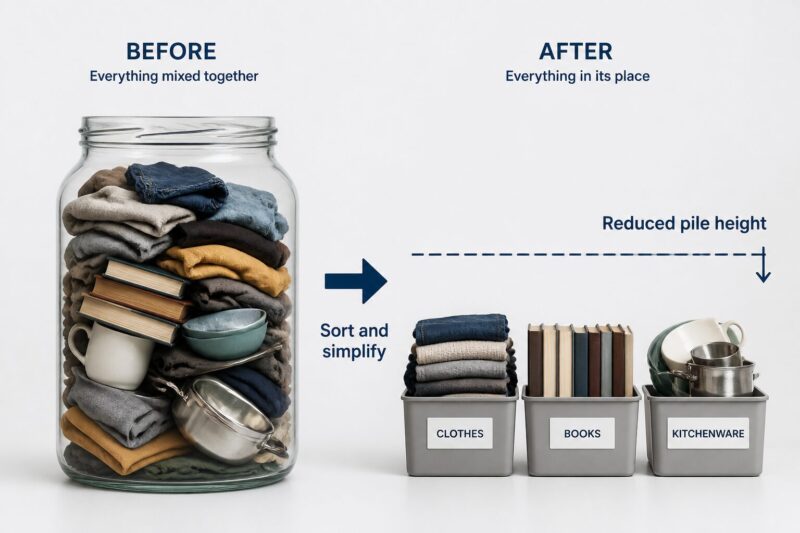
If you have a whole room to overhaul, try the ski slope technique. You start at one corner of the room and work your way around systematically—top to bottom, left to right—like a skier carving down a slope. As Elle Decor explains, this method ensures no corner gets missed.[5] I like it because it gives you a clear path and prevents you from bouncing between areas. You finish one section before moving to the next. It’s especially useful for bedrooms and living rooms where clutter is spread across surfaces, shelves, and floors.
3. The KonMari Philosophy

The KonMari method asks one question: does this item spark joy? If not, thank it and let it go. This approach is best for people who struggle with emotional attachment to belongings. Elle Decor’s comparison of sorting methods notes that KonMari is ideal for sentimental items because it gives you a clear emotional rule.[5] The downside is that it can be slow and requires a certain mindset. It works well for clothing, books, and personal mementos. If you’re the type who keeps things “just in case,” this method might help you break the habit.
4. The Moving Box Strategy
Pretend you’re moving. Pack everything in a room into boxes, then only unpack what you actually need within the next three weeks. After that, anything still in a box is a candidate for donation or sale. Elle Decor recommends this strategy for people who are unsure about what they truly use.[5] It’s a reality check: if you don’t miss it, you don’t need it. This method works wonders for kitchen gadgets, decorative items, and hobby supplies. Just be honest about what you actually reach for.
5. The Three-Group Classification
For a mudança or a serious purge, sort your belongings into three groups: essential, desired, and non-essential. Elle Decor’s lessons from downsizing show that this classification helps you prioritize what earns its place in your new space.[3] Essentials are things you use daily—toothbrush, pots, work clothes. Desired items are things you love but don’t use often—art, books, heirlooms. Non-essentials are everything else. The rule: non-essentials must go. Desired items get a limited space. This is a practical way to make tough decisions without getting bogged down.
6. The One-In-One-Out Rule
This is a maintenance rule, not a one-time purge. Every time you bring something new into your home, something old must leave. El Mueble and Elle Decor both cite this as a key discipline for keeping clutter under control.[2][3] It works for clothing, shoes, toys, and kitchen tools. The rule is simple: if you buy a new jacket, donate an old one. If you get a new pan, recycle the chipped one. This idea prevents accumulation from creeping back after you’ve decluttered.
7. The 10-Minute Daily Micro-Habit
Paper clutter is the sneakiest kind. It arrives daily as mail, receipts, and school notes. El Mueble recommends spending 10 minutes each day filing and discarding papers.[6] That’s it. Set a timer, sort through the pile, and stop when the timer rings. This small habit prevents paper mountains from forming. I use it for bills and magazines. The key is consistency—doing it every day, not just when you remember. Over a month, that’s 5 hours of paper management that never gets out of control.
8. The No-Exile Policy
Do not store decluttered items in a storage unit, your parents’ basement, or a friend’s garage. El Mueble calls this “no exilies”—exiling your clutter to another location only delays the decision.[2] If you’re not keeping it in your home, you’re probably not going to use it. Sell it, donate it, or toss it. This rule is crucial for people who struggle to let go. The goal is to remove items from your life entirely, not just move them out of sight.
9. The Two-Move Rule
Every item you use daily should be accessible in two moves or fewer. El Mueble explains this rule as a way to design your home for easy maintenance.[6] For example, your coffee mug should be in a cabinet you open with one hand and grab with the other. If you have to open a drawer, then a box, then a lid, that’s three moves—too many. This rule helps you identify storage that’s actually working. If you find yourself moving multiple things to get to one thing, it’s time to reorganize.
10. Category-Based Sorting
Instead of cleaning room by room, sort by category. Gather all your clothes from every closet, then all your books, then all your papers, and so on. Safe Storage and KonMari both advocate this method because it reveals the true volume of what you own.[7][5] When you see ten pairs of black pants scattered across different rooms, you realize you need only two. Category-based sorting is more efficient than going room by room because it prevents duplicate items from hiding. It’s a bigger upfront effort but saves time in the long run.
| Method | Best For | Time Commitment | Emotional Difficulty |
|---|---|---|---|
| Four-Box | High-clutter areas | 1–4 hours per room | Low |
| Ski Slope | Full room overhaul | 3–4 hours per room | Medium |
| KonMari | Sentimental items | Slow, per category | High |
| Moving Box | Uncertain items | 3 weeks waiting | Low |
| 10-Min Habit | Paper maintenance | 10 minutes/day | None |
Common Mistakes
Most people fail at decluttering because they try to do too much at once. They pull everything out of every closet, get overwhelmed, and put it all back. Another mistake is not having a removal plan. If you sort into boxes but never take them to the donation center, the clutter stays in your house. A third mistake is keeping things “just in case.” That broken blender you plan to fix? You won’t. Set a one-month deadline for repairs, then toss it. Finally, don’t forget to measure your space. If you’re decluttering a small apartment, check out Apartment Rooms: How to Maximize Space and Functionality for tips on making the most of limited square footage.
FAQ
Q: Do I need four boxes to declutter effectively?
Four boxes are not mandatory, but they are a common and effective structure. The four-box method usually separates items into keep, sell, donate, and trash, which makes the next step easier because every object already has a destination. You can also use bags or bins. The key is having clear categories.
Q: How long does a decluttering session usually take?
It depends on the size of the area. One source recommends 3–4 hours for a significant room-level session, while another suggests a 10-minute daily routine for recurring paper clutter. Decluttering can be scaled to both deep and maintenance work.
Q: Which decluttering method works best for sentimental items?
KonMari is the best-known sentimental-item method because it asks whether an object “sparks joy.” It is often better for people who want an emotion-based decision rule, while the four-box method is more practical for rapid sorting.
Q: What should I do with items after decluttering?
The main options are to sell, donate, recycle, or discard them depending on condition and local options. Consumer Reports stresses that removing items from the home is a necessary step, because storing them elsewhere only delays the problem.
Q: Where should I start decluttering in my home?
A useful place to start is a visible trouble spot that is already overloaded, such as a drawer, a paper pile, or a closet. Consumer Reports recommends concentrating on problem zones, and other sources recommend beginning with the smallest or simplest area first.
Q: Should I declutter by category or by room?
Several sources favor category-based decluttering, especially for clothing, papers, and mixed household items. Category-based sorting helps you see the true total of what you own, while room-based sorting can hide duplicates spread across the house.
Q: What is the cheapest way to declutter a home?
The cheapest approach is usually to use what you already have: cardboard boxes, laundry baskets, and bags for sorting. The goal is to reduce possessions first, then use simple storage only where it supports a permanent habit.
My Experience With 10 Practical Decluttering Ideas You Will Wish You Knew
I’ve tried every method on this list at least twice. The four-box method saved my garage in a single afternoon. The 10-minute micro-habit keeps my desk clear no matter how many bills arrive. But the real lesson I learned is that no single idea works forever. You need a toolkit. I start with a quick scan of the room, pick the method that matches my energy level, and set a timer. When the timer goes off, I stop. No guilt, no second-guessing. The hardest part is always the first decision—once you pick up that first object and toss it in the donate box, momentum takes over. What’s the one method you’ve been meaning to try but keep putting off?
Conclusion
Decluttering doesn’t have to be a weekend-long nightmare. Start with one drawer, one box, or one category. Use the method that fits your current mood and space. Remove sorted items from your home quickly. Maintain with daily micro-habits and the one-in-one-out rule. For more structured routines, especially if you’re organizing a shared space, you might find help in 12 Expert Preschool Classroom Ideas That Save Time—the principles of grouping and routine apply to any room. The best decluttering idea is the one you actually do. Pick one today and see how it feels.
References
- KEEPER. (n.d.). Seis consejos prácticos para ordenar y deshacerte del desorden. KEEPER. https://www.keeeper.com/es/desintoxicacion-del-hogar/
- El Mueble. (n.d.). 10 normas infalibles para aprender a tirar (sin sentimiento de culpa). El Mueble. https://www.elmueble.com/orden-limpieza-ahorro/10-normas-infalibles-para-aprender-a-tirar-sin-sentimiento-de-culpa_43899
- Elle Decor. (n.d.). Cuatro valiosas lecciones sobre ordenar y tirar cosas que aprenderás después de mudarte. Elle Decor. https://www.elledecor.com/es/decoracion/a61725999/lecciones-mudarse-objetos-limpieza/
- YouTube. (n.d.). ¡Acaba con la acumulación AHORA! 10 métodos para deshacerte de todo lo que NO necesitas. YouTube. https://www.youtube.com/watch?v=KdVi7g6cCzg
- Elle Decor. (n.d.). Soy una experta en orden y estos son los 5 métodos para ordenar tu casa. Elle Decor. https://www.elledecor.com/es/decoracion/a60356018/metodos-orden-casa-mejores/
- El Mueble. (n.d.). Orden en casa: más de 90 trucos de orden infalibles. El Mueble. https://www.elmueble.com/decoracion/51-trucos-orden-infalibles_41749
- Safe Storage. (n.d.). Deshacerse de cosas que no usas. Safe Storage. https://safestorage.pe/deshacerse-cosas-no-usas/
- Consumer Reports. (n.d.). Cómo deshacerte de las cosas que no necesitas. Consumer Reports. https://www.consumerreports.org/es/hogar-y-jardin/como-deshacerte-de-las-cosas-que-no-necesitas-a4586635280/

A Teacher with 5 years of experience. Our Expertise, is reliable to meet your full Academic development needs . Worked on many crafts and construction projects offering services from design to development to deployment over the years. You will find many of my works in my business portfolio on request.