What separates a practice sketch from one you actually finish? The right manga art ideas make the decision easy. These 14 prompts target specific skills—body construction, paneling, pacing, and character design—so every drawing session moves you forward. Whether you are sketching on a Tuesday night or planning a weekend comic page, each idea here connects to a technique you can apply immediately. Pick the ones that fit your current goal and start.
Quick Questions and Answers
Question: Why are proportions important in manga art?
Answer: Proportions ensure characters look balanced and convincing. Using reference images helps you place body parts correctly—mistakes like drawing an elbow where a knee should be vanish when you practice proportion drills. Without good proportions, even expressive faces and cool outfits fall flat.
Question: Can beginners draw cute manga girls easily?
Answer: Yes. Start with simple shapes and basic features—a smiling face or a wink. These easy digital drawings build confidence fast while teaching you the foundation of manga character design.
Question: Do manga drawings use geometric shapes?
Answer: Definitely. Artists construct heads, bodies, and poses using circles, triangles, and rectangles. This geometric framework keeps proportions consistent and makes it easier to replicate expressions across multiple panels.
Key Takeaways
Focus your practice on one skill at a time: body construction, paneling, pacing, or expression.
Use reference images. Even pros do.
Rotate ideas frequently to avoid getting stuck in one style.
Track your progress by saving one version of each exercise.
1. Chibi Body Construction and Proportion Practice
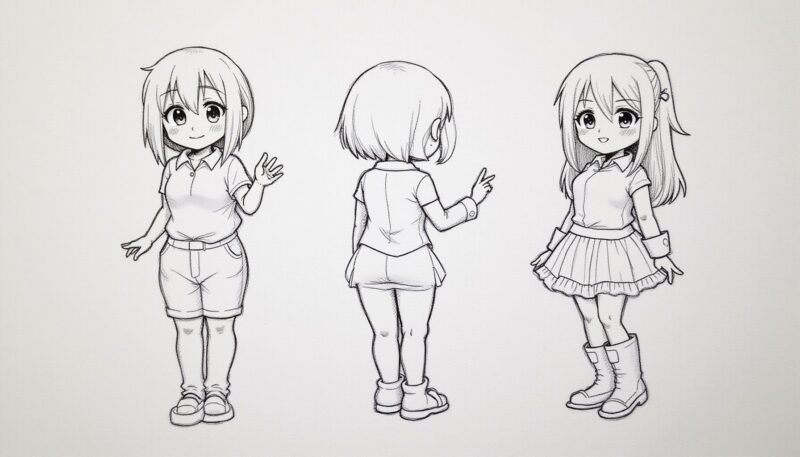
Chibis are the perfect sandbox for learning proportions. Their simplified bodies let you focus on how joints align and where mass sits without getting lost in anatomical detail. According to a manga drawing book roundup from JapanTruly, building chibi characters trains basic body construction techniques that apply directly to standard character drawing.
Draw the same chibi in five different poses—sitting, jumping, pointing, running, waving. Keep the head-to-body ratio consistent (usually 1:1 or 1:2). If the proportions shift between poses, you know where to drill next.
Best for: Beginners who want to understand body structure without getting overwhelmed.
2. Animals in Action
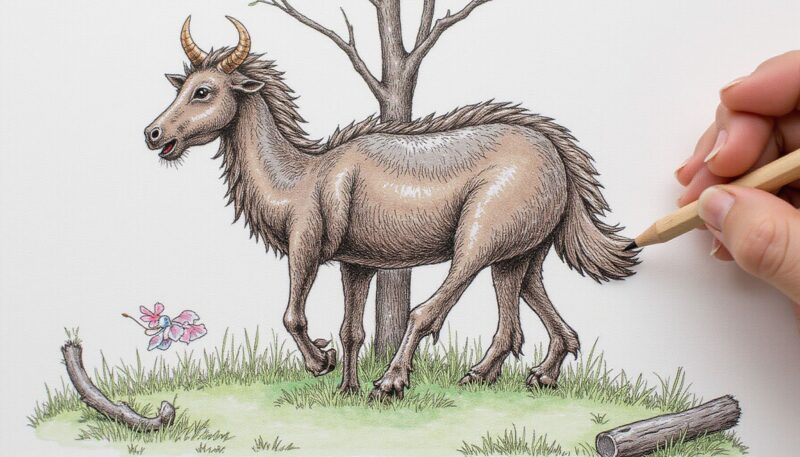
Animals move differently than humans. Drawing them forces you to observe real muscle groups and joint ranges. The JapanTruly book roundup specifically recommends “animals in action” as a core skill because it teaches dynamic posture that transfers back to human characters.
Start with a leaping cat or a running fox. Use photo references for the base pose, then exaggerate the motion lines to push the action further. Compare two versions—one realistic, one stylized—and note which reads as more energetic.
Best for: Artists who want their characters to feel alive on the page.
3. Manga Paneling: Establishing Shots First
A manga page can look confusing if the reader doesn’t know where they are. The rule of establishing shots solves this. As the beginner paneling guide from MangaFlow explains, every scene needs a wide panel that sets location and context before cutting to close-ups.
Create a three-panel page: establishing shot (wide), medium shot (character enters), close-up (expression or action). Repeat the same structure with three different settings—a park, a classroom, a rooftop.
Best for: Storytellers who want readers to instantly understand the scene.
4. Reading Direction Panel Exercise
Generating image 5…
Manga reads right-to-left in Japanese, but many Western-style manga reads left-to-right. Pick your direction and stick to it. MangaFlow lists reading direction as a foundational concept because mismatched panel flow breaks immersion.
Draw a four-panel sequence that forces the eye to follow your chosen direction. Number each panel lightly in pencil to check the flow. Show it to a friend—if their eyes jump around, adjust the layout.
Best for: Beginners making their first full pages.
5. Gutter Control Challenge
Gutters—the space between panels—control pace and clarity. MangaFlow lists gutters as a key paneling element. Tight gutters create urgency; wider gutters give breathing room.
Draw the same two-panel scene twice. Version one uses narrow gutters (2mm). Version two uses wide gutters (8mm). Notice how the same action feels faster or slower based purely on spacing.
Best for: Learning how silence and space affect reading pace.
6. Panel Size and Shape Variation for Mood
A tall narrow panel emphasizes height or tension. A wide panel suggests openness or travel. MangaFlow explains that panel size and shape directly control pacing and mood.
Design one page with at least three distinct panel shapes—a tall vertical, a long horizontal, a small square. Place them in an order that builds tension then releases it. Compare to a page where all panels are identical rectangles. The difference is immediate.
Best for: Adding emotional texture to your layouts.
7. Eye Movement Layout with Dialogue Balloons
Dialogue balloons guide the reader’s eye as much as panel borders do. A paneling and pacing resource from Scribd emphasizes “directing a reader’s eye movement through panel and dialogue balloon layout.”
Draw a six-panel page where the dialogue balloons force a zigzag reading pattern. Place the first balloon top-left, second mid-right, third bottom-left, fourth bottom-right. Test it by tracing your own eye movement afterward.
Best for: Pages with complex conversations or overlapping action.
8. Dialogue Timing Sequence
Pacing in manga isn’t just about panels—it’s about when words appear. The Scribd resource frames “pacing stories” as a function of panel and dialogue balloon arrangement.
Write a short exchange (four lines of dialogue). Draw it twice. Version one: one line per panel, wide gutters. Version two: two lines per panel, tight gutters. The same words read completely differently.
Best for: Writers who draw and want to control story rhythm.
9. Multi-Panel Comic Strip (3–6 Panels)
Strip practice builds sequential muscle without the pressure of a full page. A Pinterest paneling set specifically includes “Comic Strip With Multiple Panels” as a practical exercise.
Draw a six-panel strip of a character making breakfast. Use an establishing shot, three action panels, a reaction panel, and a payoff panel. Keep backgrounds minimal. Focus on clear progression.
Best for: Daily warm-ups that reinforce layout fundamentals.
10. Sequential Art Storyboard Page
Storyboarding moves from strip to page. A Pinterest inspiration set references “Sequential Art” as a distinct skill—connecting panels into a complete narrative flow.
Map a 12-panel page with no dialogue. Use panel size and shape to control pacing (wide for slow, small for fast). The story should be readable without a single word balloon.
Best for: Visual storytelling without relying on text.
11. Weekly Panel Layout Rotation from Inspiration Boards
Dedicated manga paneling tips boards exist to help you “try out new things.” Pull one layout concept each week and redraw it in your own style.
Week one: a full-page splash. Week two: a nine-panel grid. Week three: overlapping panels. Rotating prevents you from defaulting to the same layout every time.
Best for: Breaking out of repetitive page patterns.
12. Community-Friendly Paneling Challenge
One community pin notes the creator is “not a mangaka” yet still finds paneling resources helpful. That’s the spirit. Set a low-pressure challenge for yourself: redraw a complex page layout as a simplified version.
Pick a professional manga page, trace the panel outlines only, then fill in your own characters and story. This removes the intimidation while teaching you how pros structure pages.
Best for: Beginners who feel overwhelmed by publication-level polish.
13. Replicate a Panel Design Tutorial, Then Rewrite It
A Pinterest tutorial pin explicitly frames itself as “Manga Paneling Tips and Tutorial” with “Manga panel design” content. Replicate that layout exactly, then change one variable—swap panel shape or gutter width.
After you follow the tutorial once, redraw it with your own scene. Compare both versions. The fix you made reveals what you actually learned.
Best for: Methodical learners who like structured practice.
14. Pacing-First Page Variation
The core insight from the Scribd resource is that pacing comes first—details second. Produce two versions of the same scene where only the panel and dialogue layout changes.
Version one: fast-paced (small panels, tight gutters, short dialogue). Version two: slow-paced (large panels, wide gutters, longer dialogue). Show both to someone and ask which scene felt more urgent.
Best for: Understanding that layout is storytelling.
Comparison Table: Best Option for Each Drawing Goal
Idea
Best For
Core Skill
Source
1
Character design basics
Chibi proportions
JapanTruly book roundup
2
Dynamic posing
Animals in action
JapanTruly book roundup
3
Narrative setup
Establishing shots
MangaFlow beginner guide
4
Page readability
Reading direction
MangaFlow beginner guide
5
Clarity and spacing
Gutters
MangaFlow beginner guide
6
Speed and mood control
Panel size/shape
MangaFlow beginner guide
7
Story comprehension
Eye movement layout
Scribd paneling resource
8
Dialogue rhythm
Pacing through balloon placement
Scribd paneling resource
9
Sequential skill
Multi-panel strips
Pinterest inspiration set
10
Full story flow
Sequential art board
Pinterest inspiration set
Common Mistakes
The biggest one is skipping practice with paneling fundamentals. Many artists jump straight to character design without learning how to lead the eye across a page. Another is ignoring gutter spacing—it’s easy to treat gutters as dead space, but they control pacing more than anything else.
Beginners also tend to draw the same panel layout every time. Rotating through different structures builds flexibility. And watching your practice becomes more effective when you compare versions side by side.
My Experience With 14 Manga Art Ideas You’ll Want to Draw Right Now
I started with idea 1—chibi construction—and immediately realized how much I’d been guessing about joint placement. Drawing the same character in five poses forced me to learn what a “correct” proportion actually looks like. My second attempt at a running cat looked like a stretched sock. My fifth looked like an actual animal.
What surprised me most was idea 5: gutter control. I made two versions of the same scene with different spacing. The tighter-gutter version felt panicked. The open-gutter version felt melancholy. Same characters, same dialogue, completely different mood. That’s when I understood that layout is storytelling.
I still mess up eye movement occasionally. Dialogue balloons drift, and suddenly the reader is jumping from bottom-left to top-right without meaning to. But catching that mistake now feels like progress, not failure.
What’s the one manga skill you keep avoiding? Maybe it’s time to try it here.
FAQ
Q: Are ponytails and cat ears popular in manga?
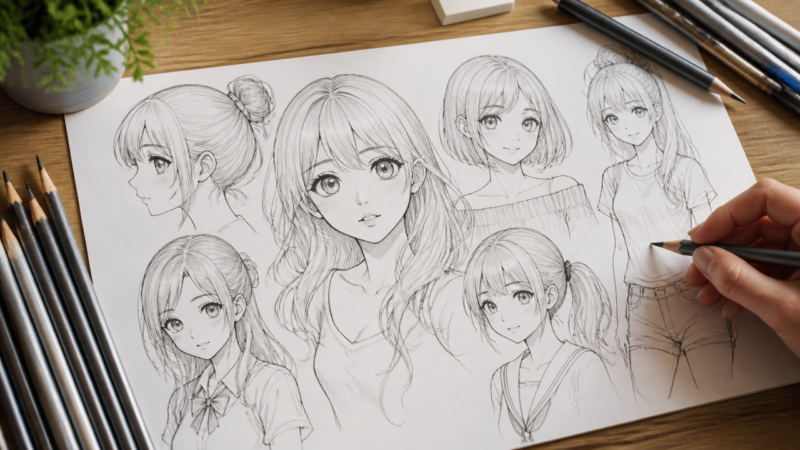
Yes. Ponytails and cat ears are common stylistic choices that give characters an adorable or quirky look. A simple drawing of a cute manga girl with two ponytails and cat ears is a popular beginner exercise. These features add personality and make characters more memorable.
Q: How do you draw expressive manga faces?
Start with basic emotions—happy, sad, angry, shocked. Then exaggerate for intense expressions like an “intense scream” where the character yells loudly. Simple lines, strategic shading, and added objects like sweat drops or blush marks can enhance the feeling.
Q: What is the best way to draw manga hands?
Study how fingers bend, how the thumb moves, and how the hand changes shape when gripping something. Practice regularly using real hands as reference or photos. Over time, you’ll produce hands that look natural and avoid common mistakes like T-rex arms.
Q: Why should artists use perspective grids?
Perspective grids place vanishing points accurately and maintain spatial relationships. Using one-point, two-point, or three-point perspective with grids ensures buildings and objects align correctly. This prevents guesswork and improves scene depth.
Q: Can you draw manga characters with headphones?
Yes. Drawing a girl listening to music with headphones is a beginner-friendly digital drawing idea. It combines simple elements like headphones and music notes with character expressions, making it both fun and visually appealing.
Q: Do manga artists use screen tones for shading?
Yes, traditionally. Screen tones are a film used for shading and creating grayscale patterns. Many artists now use digital tools like Photoshop or GIMP to add screen tones and adjust contrast directly on their computers.
Q: What is a simple idea for drawing manga boys?
A simple idea is drawing a “handsome anime boy” or a male character with glasses. These ideas are beginner-friendly and good references for fixing issues like the “other eye” problem. They help improve skills in drawing digital anime and manga characters.
A Teacher with 5 years of experience. Our Expertise, is reliable to meet your full Academic development needs . Worked on many crafts and construction projects offering services from design to development to deployment over the years. You will find many of my works in my business portfolio on request.