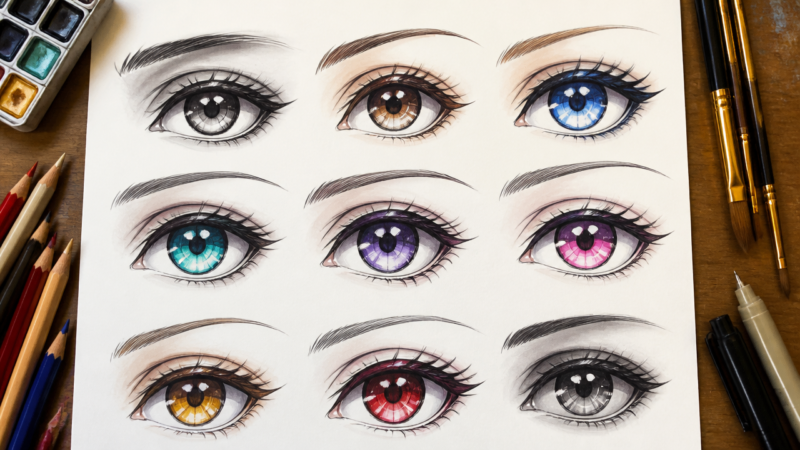
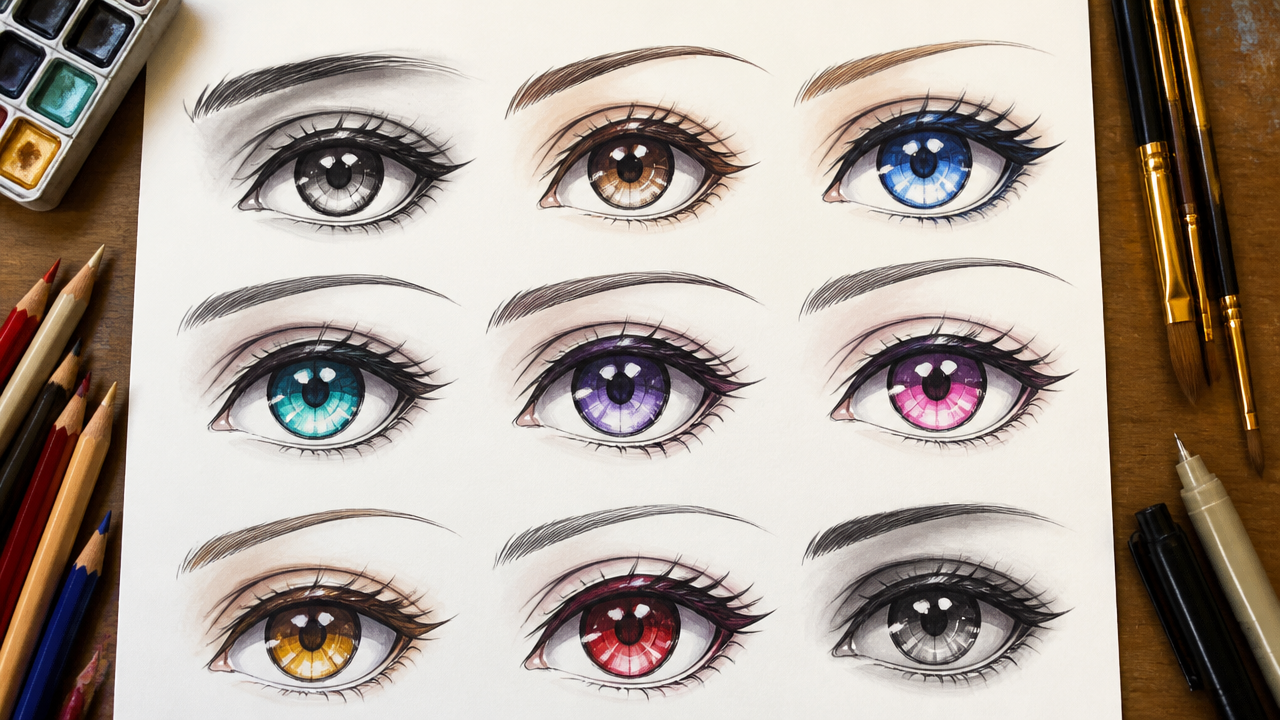
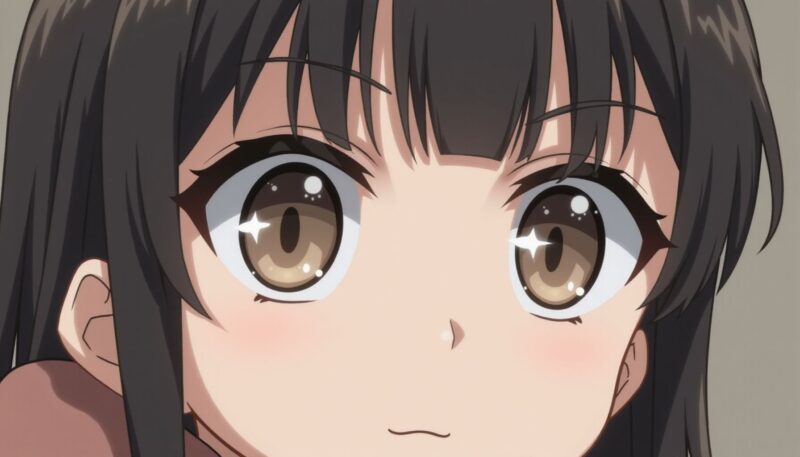
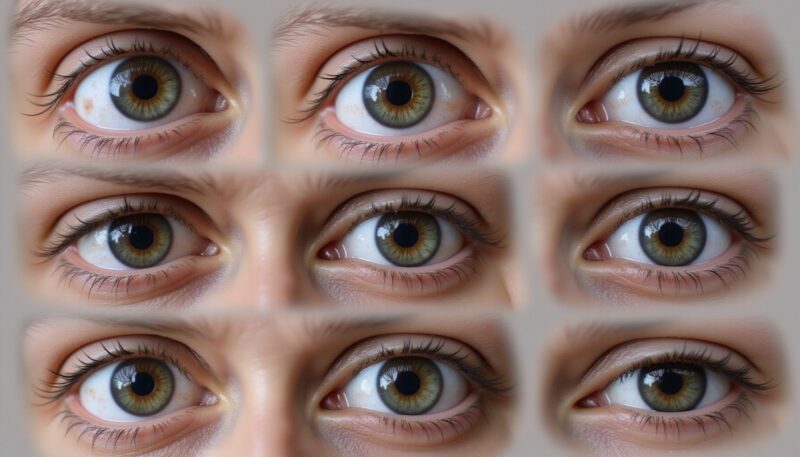
What makes manga art reference eyes look right on the first try, whether you chase iconic manga eyes or more realistic eye styles? When you study manga eye reference, you’re really studying light, shape language, and emotion signals—so the right references make sketching feel calmer. For after-school practice, weekend fanart, and holiday gift art, good manga eyes reference will save hours of “why does this look off?” work. Grab 12 distinct manga eye styles and test them today so your character faces get stronger, quicker.
Quick Questions and Answers
Question: why do manga eyes look so shiny and realistic?
Answer: Manga eyes are known for their shiny, realistic look because artists use contrast with light and dark shades. They layer light, mid, and dark tones and add a jet-black highlight to create a glossy effect that mimics real eye reflections[1].
Question: can I draw manga eyes with just basic markers?
Answer: Yes, you can draw manga eyes using just three different markers and one black colored pencil. Artists often use three shades of brown—light, mid, and dark—to create depth without needing complex tools[1].
Question: do manga eye styles change depending on the character?
Answer: Manga eye styles vary based on the character’s emotion, personality, and the anime series. For example, tired characters may have lines under their eyes, while angry ones show downward lines and wrinkles[3].
Key Takeaways
You’ll get the fastest improvement by matching the reference style to your goal: readability (iconic), consistency (same character across scenes), or emotion control (brows and lid lines). Pick references that clearly separate sclera and pupils, because manga often keeps sclera dominant with small pupils. Then practice remixing—don’t copy one eye forever.
How to Choose Manga Art Reference Eyes (Ranking Criteria)
I rank eye references by how clearly they teach the “read” of the eye first, then the “render” second. That means you want references that show the iconic-to-realistic range, not just one pretty example you can’t reproduce.
Spectrum clarity matters. CharacterHub points out that manga eyes can lean heavily iconic, with eyes that are almost entirely sclera except for small pupils, and it also describes the eye design as a spectrum from iconic to realistic[1]. When a reference set shows that contrast clearly, you can scale it up or down without losing the core look.
Consistency across scenes is the next test. When CharacterHub warns that One Piece eye styles can vary wildly, that’s a cue to include reference examples that help you practice staying consistent even when a series changes the “default” eye read[1]. You want enough variety to train your eye language, not just enough to feel inspired.
You also need emotion-specific cues. AnimeOutline frames its resource as a guide to different styles of male anime and manga eyes, with examples and tips for drawing them, so you can build shapes that shift with mood rather than drawing one “neutral” eye forever[2]. If your characters look stiff, your reference set is probably missing expression levers.
Lastly, I favor references that break structure down. Pinterest boards focused on manga eyes tend to compare eye parts and structural differences between realistic eyes and manga approaches, and many creators point out that the eye area is where you inject the most life into a face[4]. Reddit’s mix-and-match reference sheet approach also helps—if you can swap eye shapes with a consistent face plan, you learn faster than by copying a single character screenshot[3].
12 Stunning Manga Art Reference Eyes (Styles to Try Today) — Ranked Picks
1. Iconic Sclera-Heavy Eyes (Small Pupils That Read Fast)
CharacterHub notes that manga eyes often lean iconic, with eyes that are almost entirely sclera except for small pupils[1]. That design choice makes the eye read instantly, especially at smaller sizes or quick sketch thumbnail stages.
I like this style when you want clear character silhouettes and strong expression without over-rendering. It’s also great if your biggest struggle is “my pupils disappear when I shrink the face.”
2. Iconic-to-Realistic Spectrum Variants (Same Emotion, Different Rendering)
CharacterHub explicitly frames manga eyes as a spectrum from iconic to realistic[1]. When your reference set includes multiple versions across that spectrum, you learn which parts you can exaggerate and which parts you must keep grounded.
Use this pick when you want to draw the same character face across scenes: calm, intense, surprised. If your eyes change too much between panels, this reference approach trains consistency without locking you into one look.
3. One Piece-Style Variant Sets (Train Consistency Through Chaos)
CharacterHub cautions that One Piece can be tricky because the style of eyes presented in the manga can vary wildly[1]. So instead of avoiding that variability, study it directly with a reference set that shows multiple eye looks from that kind of spectrum.
I recommend this for intermediate artists who can already draw a basic eye shape and want to practice “staying you” even when the series leans in new directions. It’s not beginner-friendly, but it’s extremely effective.
4. Male Eye Style Reference Variants (Distinct Shapes for Different Moods)
AnimeOutline presents a guide for different styles of male anime and manga eyes, with examples and tips[2]. That framing helps because you’re not hunting randomly—you’re learning how male eye shapes shift with expression and personality.
Choose this if you draw a lot of male characters, especially when anger, smugness, or seriousness should feel different in the eye alone. When the rest of your face is simple, the eyes become the main storytelling engine.
5. Emotion-Driven Brow-Above-Eye Framework (Brow Lines Do the Talking)
PainterArtist emphasizes eyebrows as a key emotion lever, using thicker arched lines above the eye that contour to the overall shape of the top lid[7]. That’s a big deal because manga reads emotion through line placement, not just pupil shape.
Try this reference style when you feel like your characters “look the same” across expressions. You’ll tighten emotions fast because brows change the perceived attitude before the viewer even lands on the iris.
6. Eye Parts Structural Comparison (Realistic vs Manga Rendering Lessons)
Pinterest’s manga eyes collections often focus on eye structure and comparisons between realistically drawn human eyes and manga approaches, and they point out that the eye area is where you can inject the most life into a face[4]. I like comparison-style references because they teach what to change, not just what to copy.
Use this when you want your manga eyes to feel more alive without turning your work into full realism. You’ll learn which structural cues survive stylization, like lid tension, highlight placement, and pupil shape.
7. Remixable Mix-and-Match Reference Sheet Eyes (Build Faces Like a Kit)
A Reddit reference sheet approach is meant to help people by providing different eye types that can be mixed with mouth and nose types to put on a face[3]. That’s huge for practice because you stop treating eyes as “finished art” and start treating them as interchangeable components.
Pick this if you do character design iterations or you sketch thumbnails for costume and hairstyle variations. Remixable references make you move faster, and speed helps you see patterns.
8. Sketch-First Eye Collection (Warm Up With Fast Beginner Sketches)
DrawingRef positions its anime and manga eyes reference collections as useful drawing references and sketches for beginner artists[6]. That focus matters because it encourages repeated reps, not just one polished copy.
Use this when you’re warming up, refining a new style, or testing a new tool set. Sketch-first references also help you avoid spending 90 minutes on one eye and then abandoning the panel halfway through.
9. Franchise-Template Style Boards (Match the Eye Read to the Vibe)
Pinterest boards can include template-style options for eye drawings tied to recognizable franchises or universe vibes, such as Harry Potter, Marvel, Boku no Hero Academia, and The Umbrella Academy[5]. I’m not saying templates are “better.” I’m saying templates reduce guesswork when you want an eye read that matches a specific tone.
Try this pick when you’re designing fanart or trying to replicate a known character mood. Use templates to study style cues quickly, then adapt them so your version still looks like you.
10. Curated Manga Eyes Browsing Boards (Learn by Rapid Thumbnailing)
A Pinterest collection like 48 Best Manga eyes ideas is built for browsing many shapes quickly, which makes it excellent for generating sketch thumbnails and testing variations fast[8]. When your goal is exploration, curated browsing beats deep single-image study.
Choose this if you’re stuck in a loop—drawing the same eye again and again. Quick browsing helps you break the loop and find a shape you didn’t think to try.
11. Guided Tips-and-Examples Learning (Study Methods, Not Just Pictures)
AnimeOutline frames itself as a guide and reference with examples and tips for drawing different styles of male anime and manga eyes[2]. That “tips” angle matters because you can replicate the process, not just the end result.
Use this for practice sessions where you want structure: one sitting equals one eye style, one mood, one lighting approach. You’ll improve faster because you’re training decisions, not only shapes.
12. Art-Style Matching Picks (Dirt-Punk Aesthetic Eyes That Fit the World)
Collider highlights a dirt-punk aesthetic that may seem messy but ties to world, story, and themes, and it cites Dorohedoro as an example of that kind of art style[8]. When you pick eye references that match the broader art direction, your characters feel like they belong in the same universe.
I recommend this for artists who want their eyes to stop looking pasted-on. Start with art-style references, then adjust eyes so the line weight, shading intensity, and highlight style match the world.
A quick comparison table to pick your next study
Option
What it teaches
Best for
Watch-outs
Iconic sclera-heavy (small pupils)
Fast readable eye “read”
Thumbnails, character silhouettes
Can look flat if you skip highlight contrast
Spectrum variants
Iconic-to-realistic control
Same character across panels
You must keep pupil shape logic consistent
One Piece-style variants
Consistency through changing styles
Advanced style adaptation
Easy to copy chaos without learning the rule
Male style variants
Mood-driven shape variety
Male character design
Avoid turning every expression into the same lid
Brow emotion framework
Expression changes from brows
Emotion practice
Pupils can get neglected if brows dominate too much
Eye parts comparisons
Structural understanding
More convincing manga eyes
Don’t over-detail or you lose manga stylization
Remixable sheet eyes
Mix-and-match workflow
Fast iteration
Needs a consistent face construction plan
Sketch-first beginner collections
Reps and fundamentals
Warm-ups, training
Polished copies get you fewer reps than quick loops
Franchise-template boards
Vibe-matched cues
Fanart style matching
Templates can trap you into sameness
Curated browsing boards
Thumbnail exploration
Idea generation
You may collect images without practicing
Guided tips-and-examples
Learn the method
Structured practice
Reading tips won’t help without drawing time
Art-style matching
Line/shading fit
World-consistent art
Style mismatch makes eyes look pasted-on
Who Each Option Is Best For (Quick Match)
If you’re a beginner, start with sketch-first collections and easy browsing. DrawingRef’s beginner-focused sketch idea is built for practice loops[6], and Pinterest-style “many ideas” boards help you warm up by searching for shapes quickly[8]. Both reduce the intimidation factor because you can try more variations per hour.
If you want readable iconic manga eyes, prioritize references that keep sclera dominant and pupils small. CharacterHub’s description of manga eyes being almost entirely sclera with small pupils is basically an instruction for clarity[1]. Use that as your baseline when your eyes vanish at smaller sizes.
If you want stronger emotions without redrawing the entire eye, focus on brow and lid line behavior. PainterArtist’s approach of thicker arched eyebrows above the eye, contouring to the top lid shape, trains your emotion changes efficiently[7]. Your characters will feel more expressive even when the rest of the face stays simple.
For male characters, study a reference set that explicitly includes male eye style variations with tips. AnimeOutline is built that way, so it supports practice where eye shape, lid line, and expression feel distinct[2]. That helps avoid the “same eyes, different mood” problem.
If you like rapid experimentation and character design iteration, remixable reference sheets win. Reddit’s mix-and-match idea (eye types plus mouth and nose types for a face) helps you test combinations quickly[3]. When you treat eyes as modular, you stop waiting for inspiration.
Finally, if you care about how eyes feel inside a specific art direction, match to broader style cues. Collider’s discussion of art style tied to dirt-punk world feel is the mindset shift here—your eyes should share that visual logic[8].
Buying or Choosing Advice (How to Pick What to Use Today)
First, decide what you want to fix. If your drawings look hard to read, choose references that clearly show sclera-heavy eyes and small pupils, then practice a few quick sketches at different sizes. CharacterHub’s iconic-leaning description gives you a strong starting target[1].
If your characters don’t stay consistent across expressions, switch to spectrum variants and do side-by-side studies. CharacterHub’s “spectrum of iconic to realistic” framing is a reminder that your style can shift—so you need training references that show that movement[1].
If you struggle with emotion, pick references that teach expression levers you can control. PainterArtist’s brow-above-eye framework gives you a concrete path: thicken and arc the brow line to match the mood, then rebuild the eye so it agrees with the brow[7].
If you’re building character models, use remixable sheets or curated templates so you can iterate without starting from zero. Reddit’s mix-and-match reference logic helps you rapidly test face combinations[3], while Pinterest’s franchise-style template collections help you match a known vibe faster[5].
And when you’re bored of copying and you just want to “feel” like the character, browse curated eye boards or do thumbnailing passes. Pinterest collections like 48 Best Manga eyes ideas are made for fast shape browsing and variation testing[8].
My Experience With 12 Stunning Manga Art Reference Eyes (Styles to Try Today)
I used to think the “real skill” in manga eyes was drawing the iris perfectly. Then I tried practicing directly from eye references that separate sclera and pupils clearly, and my eyes suddenly looked way more readable at smaller sizes. That iconic approach really clicked for me because it gave me a consistent eye read instead of a different micro-style every sketch[1].
My biggest mishap? I copied an eye from a cool board, loved it for five minutes, and then my character’s expression looked wrong because I ignored the brow-and-lid logic. Once I started treating eyebrows as the emotion switch—thicker arched lines contouring to the top lid—my characters stopped feeling flat[7]. (My sketches also got faster, which I guess is what you get when your brain stops panicking.)
Here’s my expert bias: if you can’t remix the eye quickly, you’re still studying “a picture.” Remixing forces you to learn the structure behind it, like the Reddit mix-and-match sheet idea suggests[3]. What eye style are you practicing right now, and what part keeps throwing you off?
Common Mistakes
A common mistake is copying one beautiful eye without learning the rule behind it. If the eye read relies on small pupils and strong contrast, then copying a detailed iris alone won’t give you the same effect at sketch size. CharacterHub’s “sclera-dominant with small pupils” framing is a good clue for what you should keep consistent[1].
Another mistake is ignoring emotion levers. If your references don’t show how brows, lid tension, or under-eye lines change with mood, your characters will look like they’re wearing the same expression on different days. PainterArtist’s brow-above-eye approach exists because brows carry a lot of the emotional data[7].
People also over-detail too early. When you start with realism-level rendering, you usually lose the stylized logic that makes manga eyes work. Pinterest’s structural comparisons can tempt you to copy too much from realistic eyes. Use comparisons to learn what changes, not to transplant everything[4].
Finally, practicing only one style makes you fragile. If your reference set has one look, you end up drawing that look even when the character would call for a different eye style. CharacterHub’s note about wide variation in some series is a reminder that your practice should include multiple modes[1].
FAQ
Q: are there specific rules for drawing manga eyelids?
Yes, the upper eyelid is usually drawn with thicker lines to show more lashes, while the lower eyelid is thinner. Some styles add a second line or shading under the lower eyelid for detail[3]. If your eye feels “wrong,” compare your lid line weights first before you redraw the iris.
Q: how many different manga eye styles are there to learn?
There are at least 20 distinct manga eye styles shown in tutorials, ranging from simple shonen designs to complex, detailed anime eyes. Artists can use these for reference or to create original designs[2][3]. Instead of trying to learn them all at once, pick one or two styles and practice variations of the same emotion.
Q: does shading make manga eyes look more realistic?
Shading adds depth and realism by using screen tones or pencil gradients to mimic light and shadow. Simple shading can transform basic shapes into striking, lifelike eyes without overcomplicating details[2]. If your eyes look flat, try adding mid-tones before you add more highlights.
Q: when should I use thick lines for manga eyelashes?
Thick lines are best for upper eyelashes to emphasize density, while lower lashes are drawn thinner. This contrast helps create a natural, three-dimensional look that matches manga and anime conventions[3]. If the upper lashes are too thin, the eye can lose its dimensional “anchor.”
Q: is it hard to create your own manga eye design?
Creating a unique manga eye design is not hard if you start with a basic shape like a circle and morph it organically. Adding eyelashes, varying pupil shapes, and shading can make it distinct[3][4]. Your “original design” can start as a remix, then refine once you know what changes the read.
Q: what tools do beginners need to draw manga eyes?
Beginners need minimal tools: three markers, a black colored pencil, and optionally a dark shade for highlights. These simple items allow for layering light, mid, and dark tones to achieve depth[1]. If you only have one marker, your next best move is practicing tonal steps, not swapping tools.
Q: which manga series has the best eye styles to study?
Popular shonen manga series like Dragon Ball, Naruto, and One Piece have iconic eye styles worth studying. Analyzing their characters’ expressions helps artists develop their own unique style[2]. Pick one series and study expression variety panel-by-panel so you learn consistent eye language, not random cool moments.
Latest Updates or ## 2026 Trends
2026 art practice trends lean toward faster feedback loops: thumbnail passes, expression drills, and remix workflows. That’s why I keep recommending spectrum variants, remixable reference sheets, and sketch-first collections—you can test more versions per session, then lock in what works.
Conclusion
If you want manga eyes that look alive, start by picking references that teach the eye read (sclera vs pupil contrast), then add emotion control (brows and lids). CharacterHub’s spectrum thinking helps you choose references that won’t break when the character mood shifts[1]. AnimeOutline helps you narrow study to specific expression variety so your eye shapes feel intentional[2]. When you practice enough that you can remix, your eyes stop looking borrowed and start looking like yours. What kind of eye style are you trying next—iconic clarity, spectrum versatility, or emotion-driven brows?
A Teacher with 5 years of experience. Our Expertise, is reliable to meet your full Academic development needs . Worked on many crafts and construction projects offering services from design to development to deployment over the years. You will find many of my works in my business portfolio on request.