13 Brilliant Fall Drawing Ideas Everyone Should Know
Explore 13 brilliant fall drawing ideas from simple leaves to cozy scenes. Learn beginner-friendly techniques, color palettes, and how to scale difficulty
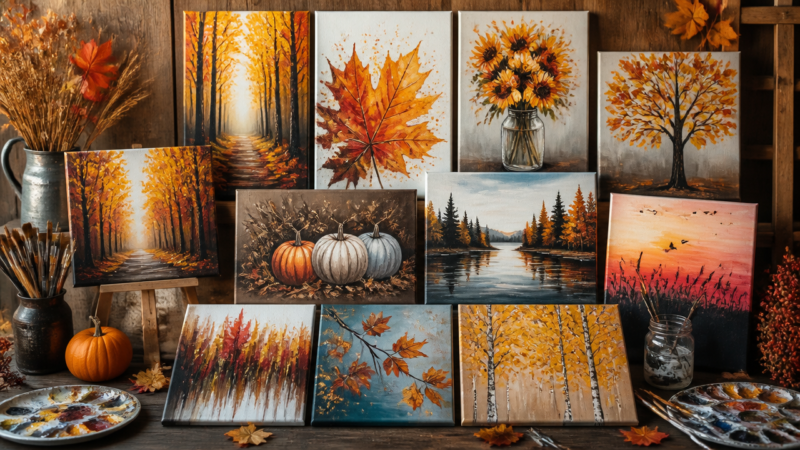
What makes a truly compelling fall drawing stand out from every other seasonal sketch you’ve attempted? The answer lies less in technical perfection and more in capturing the mood, texture, and palette that define autumn. Whether you’re drawn to the geometric precision of a maple leaf, the weathered charm of a scarecrow, or the bustling energy of a harvest festival, fall drawing offers subjects that invite both simplicity and complexity depending on your skill level. The season’s rich color transitions—from deep reds to burnt oranges to golden yellows—give artists natural inspiration that practically draws itself. Sketching during autumn becomes less of a chore and more of a celebration of the season’s visual abundance. Let’s walk through 13 ideas that will transform your sketchbook into a gallery of seasonal wonder.
Quick Questions and Answers
Question: Why do fall drawings feature pumpkins and leaves?
Pumpkins and leaves are classic fall symbols representing the harvest season and autumn’s changing colors. They’re perfect for beginners to practice shapes, shading, and experimenting with vibrant fall colors like orange, red, and brown. These subjects instantly capture the cozy, colorful magic of the season.
Question: Can I draw cute fall animals for autumn art?
Yes, drawing cute animals like foxes, cats, and squirrels surrounded by autumn leaves is a popular fall art idea. You can add personality by giving them smiling faces or hearts above their heads. Including elements like acorns, mushrooms, or pumpkins enhances the cozy autumn vibe.
Question: Do fall drawings need watercolors or just pencils?
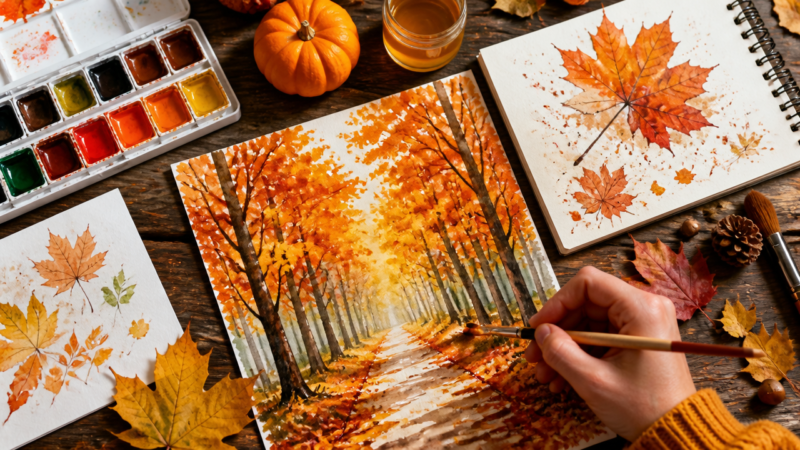
Fall drawings work with any medium, including pencils, markers, or watercolors. Watercolors are especially popular for adding loose, flowing fall colors to pumpkin or leaf sketches. However, simple pencil doodles with shading and lazy stippling can also create beautiful autumn textures.
Criteria for Choosing Your Autumn Subject
Start by honestly assessing where you sit as an artist. Beginners thrive with subjects that have clear geometric foundations—think pumpkins with their simple cap-and-stem structure, or basic leaf shapes you can build on. These give you scaffolding to work within rather than staring at a blank page and wondering where to begin.
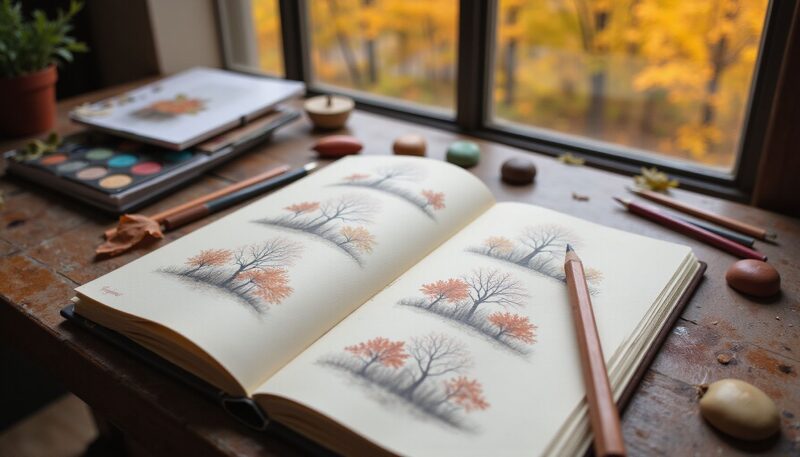
Your choice of medium matters too. Soft pastels excel at blending the atmospheric depth of an autumn forest, while graphite pencils let you build texture through layering and cross-hatching. Colored pencils split the difference, offering control with rich saturation. Consider what you already have in your studio before choosing subjects that demand materials you don’t possess.
Composition complexity is the third variable. A single maple leaf demands precision but zero composition stress. A full harvest festival scene requires you to juggle perspective, depth, and dozens of individual elements. There’s no wrong answer—just different challenges at different skill stages.
2026 Trends in Fall Drawing
Autumn art in 2026 has shifted toward cozy, grounded aesthetics that celebrate slowness over perfection. Artists increasingly favor maximalist compositions packed with layered details—think overstuffed baskets, crowded pumpkin patches, and dense forest undergrowth—rather than minimalist single-subject studies. Soft, muted color palettes are gaining ground alongside traditional bright oranges and reds, with terracotta, sage green, and dusty burgundy appearing more frequently.
Digital tools and hybrid approaches are also reshaping how fall drawings happen. Artists blend traditional pencil sketching with digital color grading, or use AI-assisted platforms to generate reference compositions and step-by-step guidance tailored to their skill level. This democratization means beginners no longer feel isolated; they can pull up personalized instruction for any subject they choose.
Criteria for Choosing Your Autumn Subject
The foundation of any solid drawing starts with honest self-assessment. Beginners should gravitate toward subjects with geometric scaffolding—pumpkins with their straightforward cap and stem, or simple leaf silhouettes that teach shape recognition without overwhelming complexity. Advanced artists can push toward high-texture work: intricate leaf veins, complex forest lighting, or detailed animal anatomy.
Medium choice directly impacts your subject selection. Soft pastels excel at capturing the atmospheric texture of autumn scenery, allowing smooth blending between light and shadow. Graphite works beautifully for detail work and structural drawing. Colored pencils offer a middle ground—control plus vibrant color saturation.
Composition scope matters equally. A single element like a maple leaf demands technical precision but zero spatial planning. A harvest tableau with multiple pumpkins, scattered leaves, and perhaps a distant scarecrow requires you to orchestrate perspective, depth, and visual balance. Neither is superior—they’re just different entry points.
## 1. Maple Leaves with Vibrant Color Transitions
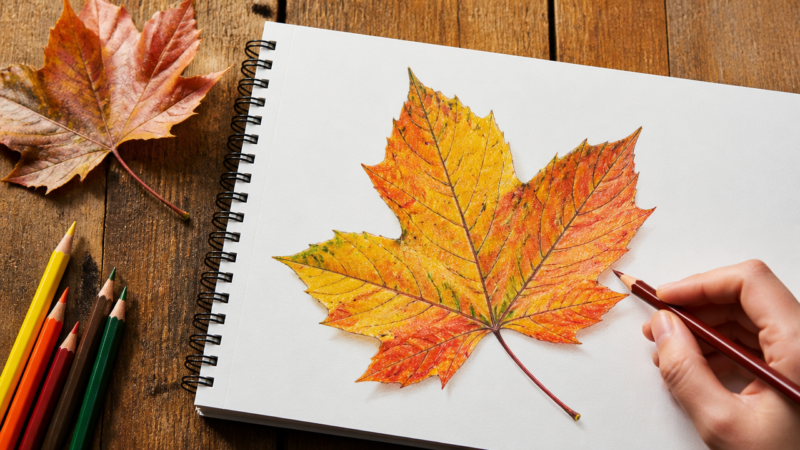
Maple leaves are the poster child of fall drawing for good reason. Their distinctive jagged silhouette is instantly recognizable, and the color palette practically paints itself: deep crimsons bleeding into burnt orange, shifting toward golden yellow at the tips.
Start by sketching the overall leaf shape lightly. Don’t obsess over perfect symmetry—real leaves aren’t mathematically precise, and slight irregularities feel more alive. Once the outline is solid, layer your colors. Apply your lightest yellow first (or leave paper white if working traditionally), then add orange, then red. Where colors meet, let them blend or overlap slightly; this transition is what makes a fall leaf feel authentic rather than flat.
The veins deserve attention but not obsession. A few strategically placed lines radiating from the central stem create the illusion of complexity without requiring you to draw every single vein. This restraint is what separates confident drawings from ones that look overworked.
## 2. Pumpkins: From Simple to Sculptural
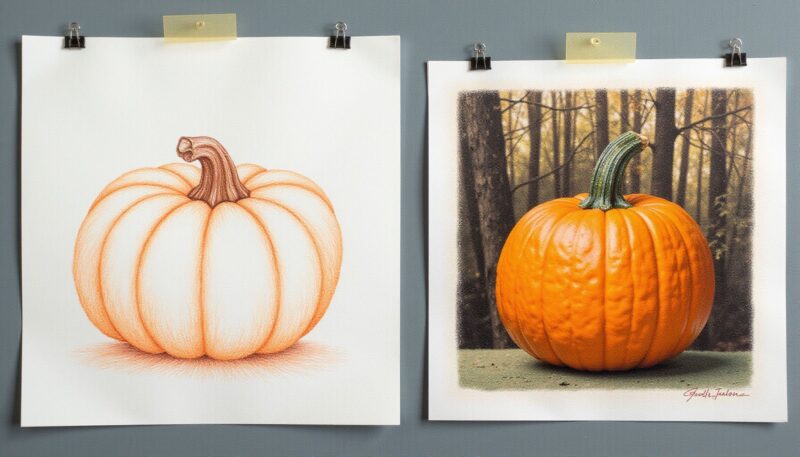
Pumpkins are the workhorse of autumn drawing—scalable from absolute beginner to professional gallery-ready work. The beauty here is that you control the difficulty slider entirely.
For beginners, focus on the essential geometry: a basic oval for the body, vertical guidelines suggesting the pumpkin’s ridged segments, and a simple stem at the top. Add a couple of leaves curling near the base, and you’re done. This version teaches proportion and basic shading without demanding mastery.
Intermediate artists can add dimension. Use cast shadows beneath the pumpkin to anchor it to a surface. Add spots or blemishes—real pumpkins aren’t flawless. Experiment with highlights showing where light catches the curved surface. Try drawing the pumpkin from an angle rather than straight-on; this angle work builds confidence for more complex compositions later.
Advanced artists take it further: deep shadows in the ridged valleys, complex leaf groupings with individual vein detail, a full background suggesting a pumpkin patch or harvest scene. Some artists render soil texture beneath, or add fallen leaves scattered around. The pumpkin becomes a launchpad for a complete narrative scene.
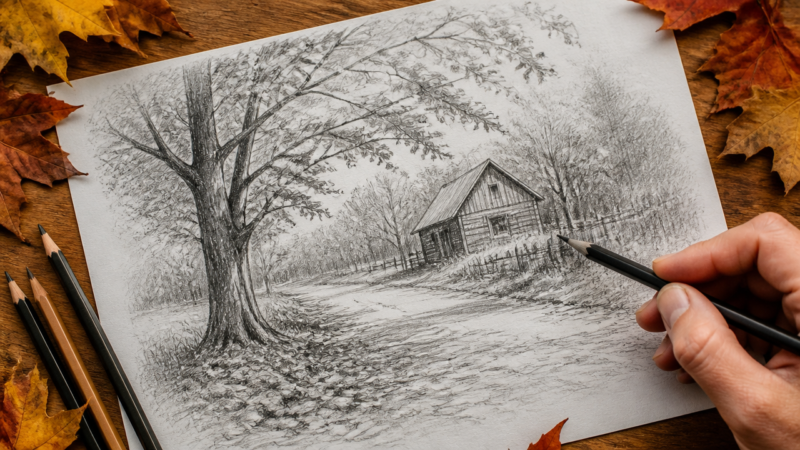
## 3. Autumn Forest Scenery with Depth
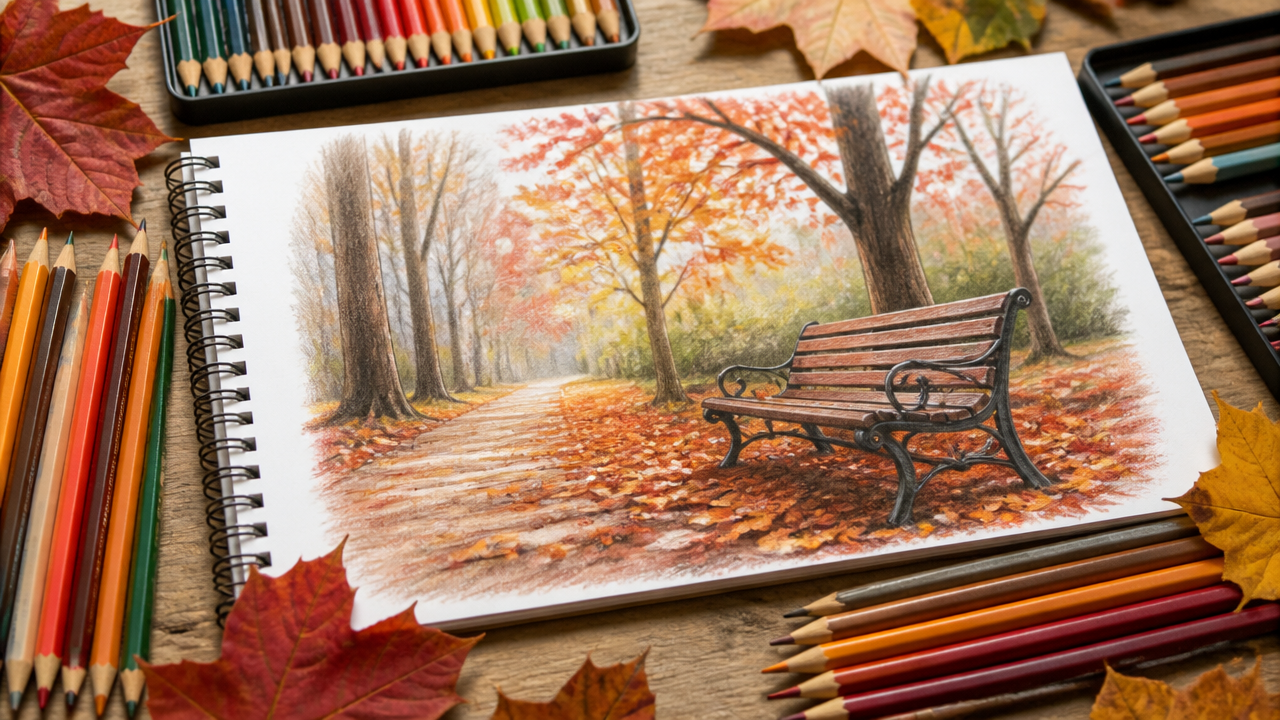
Capturing forest atmosphere is where soft pastels earn their reputation. The medium lets you blend colors and values in ways that feel effortless, creating misty depth and warm light filtering through trees.
Begin with a light sketch establishing your composition: foreground trees in detail, mid-ground trees less distinct, background trees as soft silhouettes. This depth layering is non-negotiable for believable forest scenes.
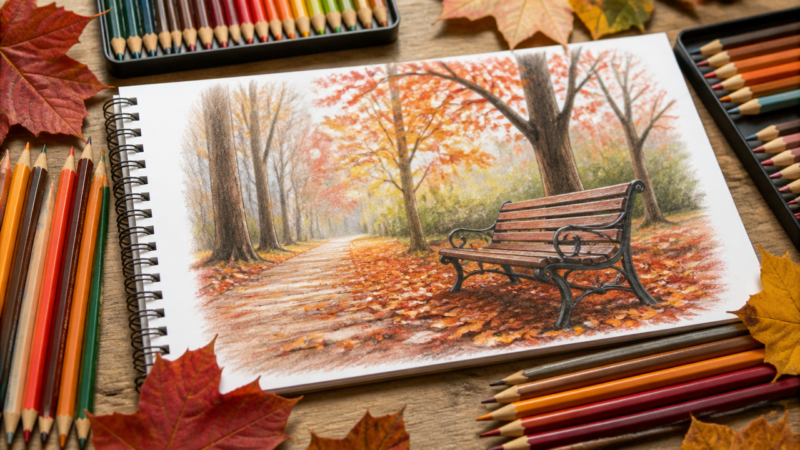
Use warm yellows and oranges for lit areas where autumn sun catches foliage. Layer cooler colors—purples, deep blues—in shadow areas. The contrast between warm and cool creates visual pop and spatial recession. Build texture by layering colors slightly unevenly; forests aren’t uniformly colored.
Foreground fallen leaves deserve their own attention. Instead of scattering random marks, group them into clumps and layers where they’d naturally collect. A few individual leaves in sharper focus at the very front draw the viewer’s eye and reinforce depth.
## 4. Scarecrows in the Harvest Landscape
Scarecrows carry nostalgic weight in autumn art, conjuring images of rural harvest traditions and pumpkin patches. They’re deceptively simple to draw once you break down the structure.
The basic scarecrow is essentially a stick figure wrapped in loose fabric. Start with a simple cross shape for the frame—vertical pole with a horizontal beam for arms. From there, roughen the lines to suggest baggy clothing. Add a head (often a burlap sack shape) sitting atop the pole. Straw protruding from cuffs and neckline adds character and texture.
The magic happens in context. A lone scarecrow standing in a field feels lonely and contemplative. A scarecrow surrounded by pumpkins or cornstalks feels purposeful and grounded in harvest ritual. The composition transforms a simple figure into a narrative statement. Use atmospheric perspective to suggest distance—the scarecrow’s details fade the further back it sits in your composition.
## 5. Deer Among Fall Foliage
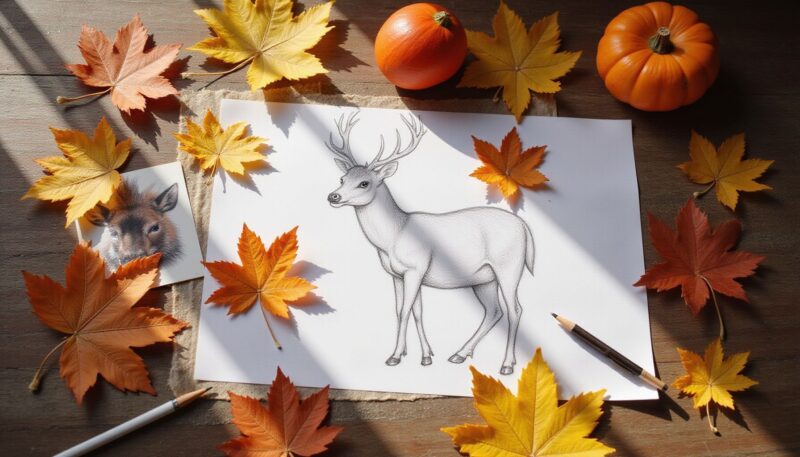
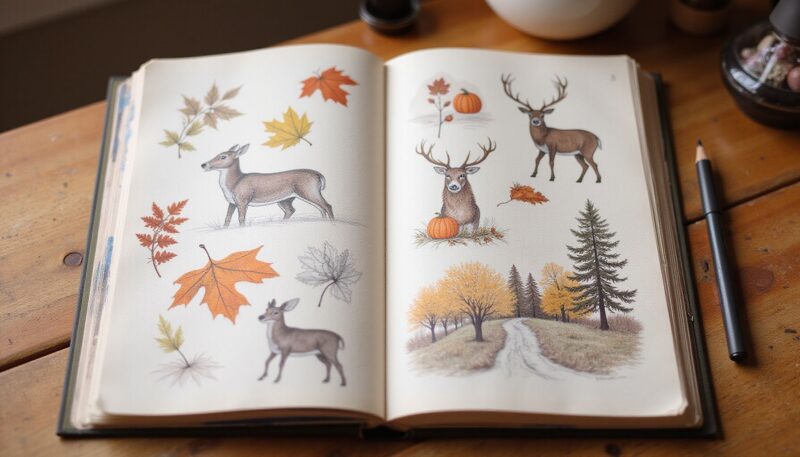
Deer anatomy looks complex until you use the foundational square method. This geometric approach demystifies animal drawing for beginners and builds solid proportion awareness.
Start by drawing a large square—this is your deer’s body and leg placement guide. Divide it into quarters; the lower half contains the legs. Sketch four simple rectangular shapes for the legs within that lower space. From the upper portion of the square, extend a neck upward, then add the head shape. Finally, crown the head with antlers using simple curved or branching lines.
Once the structure is in place, refine. Round the boxy edges. Add an eye, nostril, and ear. Suggest muscle tone with subtle shading along the neck and legs. Place your deer in a scene: surrounded by fallen leaves, standing near trees, or positioned as if grazing on low herbaceous growth.
The beauty of this method is that once you’ve done it once, it becomes automatic. You’re not “drawing a deer” from memory anymore; you’re executing a proven system. That confidence opens doors to more ambitious compositions.
## 6. Acorns and Pinecones with Texture
Acorns and pinecones are small-scale subjects perfect for sketchbook practice, studies, or as components within larger autumn compositions. Their distinct shapes teach texture rendering without demanding hours of work.
For acorns, sketch the rounded nut portion first—a simple oval or egg shape. Add the cap sitting atop, which looks like a small wooden thimble with visible texture lines radiating outward. Use stippling (small dots) or light cross-hatching to suggest the cap’s bumpy surface. The nut itself can be smooth or textured depending on your medium and preference.
Pinecones offer more visual complexity. Sketch the basic cone shape, then layer overlapping scale shapes from the base upward. Each scale is essentially a small elongated diamond or teardrop shape. Vary their size slightly and overlap them organically rather than arranging them in perfect rows. Shadows cast between scales create depth; light hitting the raised edges adds dimension.
Group acorns and pinecones together on your page. Vary angles and arrangements. A few scattered individually, some clustered, some partially hidden by leaves. This variety keeps compositions visually interesting.
## 7. Harvest Table with Fall Abundance
A harvest table composition celebrates autumn’s visual richness: apples, bread loaves, gourds, candles, dried flowers, woven baskets. The abundance and layering make this idea perfect for intermediate to advanced artists wanting to practice composition and still-life fundamentals.
Begin with perspective guidelines. A table seen at a slight angle (rather than straight-on) feels more dynamic and spatial. Sketch the basic table shape, then lightly place your major elements: a large basket, prominent gourd or pumpkin, a stack of items, background elements suggesting depth.
Work from background to foreground. Establish distance with smaller, less-detailed items in the back. Foreground items get more rendering and sharper focus. Details accumulate as you move forward: surface texture on bread, the weave pattern of a basket, individual apple dimples.
Color harmony matters here. Autumn’s natural palette is forgiving—oranges, reds, browns, greens all belong—but commit to a dominant color range. If your light source comes from the left, shadows consistently fall rightward, creating cohesive lighting logic.
## 8. Cozy Fall Scenes with Atmospheric Elements
Coziness in fall drawing comes from specific details: a steaming mug held in mittened hands, a person wrapped in an oversized sweater sitting by falling leaves, a glowing jack-o’-lantern against an evening sky. These aren’t complex compositions, but they nail mood.
The secret to cozy is warmth and softness in your mark-making and color choices. Avoid harsh black lines; use softer browns or dark grays. Rounded edges trump sharp angles. Include soft textures—knit fabric, steam wisps, fuzzy elements.
Lighting becomes a character here. Suggest warm indoor light contrasting with cool twilight outside. A candle or lamplight creates focal warmth. Shadows grow cooler and deeper, establishing depth and intimacy. Consider your viewer’s eye level; drawing from below looking up at someone wrapped in a sweater feels more intimate than a distant view.
Include symbolic fall elements subtly: a few leaves visible through a window, pumpkins on a shelf, a harvest decoration in soft focus. These details communicate season without screaming it.
## 9. Fall Color Gradient Studies
Dedicate a sketchbook page to pure color exploration. Create a series of leaf shapes or circles, then practice color transitions. Start with pure yellow, gradually shift toward orange, deepen into red, and finish with deep burgundy or brown.
This isn’t “finished art.” It’s technical practice with payoff. You’re training your eye to see color gradation and your hand to blend smoothly. You’re experimenting with how different media handle color transitions.
The repetition trains muscle memory. After completing 20 or 30 of these studies, rendering fall colors becomes second nature. Your intuition sharpens. You stop overthinking the orange-to-red transition and simply execute it.
Work with the actual materials you use regularly. If you prefer colored pencils, do the studies in colored pencil. Watercolor? Practice with watercolor. Pastels? Use pastels. This specificity means your practice directly transfers to finished work.
## 10. Harvest Moon and Night Sky
A harvest moon dominates the autumn sky in late September or early October. Drawing one teaches you about light, halo effects, and atmospheric perspective while remaining relatively simple structurally.
Begin with a perfect circle—use a compass or trace a round object if freehand feels shaky. The moon itself can be nearly white or pale yellow depending on your artistic choice and medium. Add a soft halo around it using a lighter value than the sky. This halo suggests atmospheric moisture and distance.
The sky around the moon is the real work. Depending on your vision, it might be deep twilight purple-blue, warm amber (if the moon is near the horizon), or dusky orange. Blend these colors away from the moon, creating gradation. Stars can be simple white dots or absent entirely; that’s your call.
Consider composition carefully. A moon dead-center feels static. Placing it slightly off-center, perhaps in the upper third of your composition, creates better visual interest. Add silhouetted foreground elements—bare tree branches, a distant treeline—to anchor the scene and create context.
## 11. Detailed Leaf Vein Studies
Move beyond simple leaf shapes and explore the intricate vein patterns that make real leaves botanically fascinating. This is technical work that builds precision and patience.
Select a real maple, oak, or ginkgo leaf as reference if possible. Photograph it, or press it onto your sketchbook page and trace around it lightly. Now map the vein structure. The primary vein runs down the center; secondary veins branch from it at angles; smaller tertiary veins create a network.
Use a sharp pencil or fine-tip pen for this work. Go slow. Veins don’t follow a mechanical pattern—they vary, sometimes appearing asymmetrical, often splitting unpredictably. Real botanical accuracy comes from observation, not stylization.
Once the line work is complete, add subtle shading. Veins create natural valleys in leaf tissue; shadows live in these valleys. Light hits the raised portions between veins. This light-and-shadow play makes the vein structure visually pop rather than look like clinical diagram work.
This study skill transfers everywhere. Once you understand leaf anatomy, drawing leaves contextually within larger compositions becomes easier. You’re not just drawing leaf shapes; you’re drawing actual leaves with internal structure.
## 12. Scarves, Sweaters, and Cozy Textiles
Fabric rendering teaches you about folds, fabric weight, and form-following. An oversized sweater, a knit scarf, or a thick blanket are ideal subjects because fabric’s organic wrinkles feel natural and forgiving.
Start with the garment’s basic shape. Don’t start with fabric texture; begin with structure. A sweater has a sleeve, body, and neckline. Map these simply. Now observe where fabric naturally creases and folds. At joints (elbows, shoulders, where fabric bunches), folds deepen. Fabric pulls taut along edges and sags in open areas.
Use hatching, cross-hatching, or stippling to suggest knit texture. The direction of your marks can follow fold lines, reinforcing form. Light and shadow do the heavy lifting; texture marks are just supporting players.
Layer your approach. First establish the garment’s overall form and major folds with basic shading. Then, add texture marks only in areas where fabric gathers or where you want visual emphasis. Overworking every square inch of fabric looks labored. Restraint reads as confidence.
## 13. Seasonal Wreaths and Decorative Arrangements
Autumn wreaths—arrangements of dried leaves, branches, berries, and textured elements arranged in circular compositions—teach you about symmetry, repetition, and compositional balance. They’re decorative without feeling empty.
Sketch a circle lightly. This is your boundary. Now begin placing elements around it, working clockwise or in any organized system. Vary element sizes and textures. Large focal leaves, smaller filler foliage, clusters of berries, twisted branches creating linear interest.
Ensure visual weight distributes evenly. If you place all your large elements on the left, the composition tips. Spread focal points around the circle. Some areas can be denser (more texture), others airier, but the overall balance should feel stable.
Color harmony happens naturally with autumn materials, but choose your dominant color family. Is this a red-gold wreath, or more earthy brown-green? Commit to that direction and let other colors support it.
Wreaths work beautifully as small finished pieces or as components within larger compositions. A wreath hanging on a door, viewed in perspective, becomes part of a larger cozy scene.
Idea
Best Skill Level
Complexity
Time Investment
Key Focus
Maple Leaves
Beginner to Intermediate
Low to Medium
20-45 min
Color blending & shape recognition
Pumpkins
All levels
Adjustable
30-90 min
Proportion, shading, form
Forest Scenery
Intermediate to Advanced
High
60-120 min
Depth, atmosphere, value range
Scarecrows
Beginner to Intermediate
Medium
30-60 min
Structure, context, character
Deer with Foliage
Intermediate
Medium to High
45-90 min
Animal anatomy, composition
Acorns & Pinecones
Beginner
Low
15-30 min
Texture, stippling, scale
Harvest Table
Intermediate to Advanced
High
90-150 min
Still life, perspective, detail
Cozy Scenes
All levels
Medium
45-75 min
Mood, lighting, emotion
Color Gradients
Beginner
Low
20-40 min
Color theory, blending, control
Harvest Moon
Intermediate
Medium
30-60 min
Lighting, atmosphere, spherical form
Leaf Veins
Intermediate to Advanced
High
60-120 min
Botanical accuracy, precision
Textiles & Fabric
Intermediate
Medium to High
45-90 min
Form, folds, texture rendering
Wreaths
Beginner to Intermediate
Medium
40-70 min
Symmetry, repetition, balance
Common Mistakes to Avoid
Drawing every single leaf in a forest scene is the cardinal sin of autumn composition. Your eye fills in what your pencil suggests; you don’t need to render every detail. Strategic placement of a few well-drawn leaves creates the impression of abundance without overwhelming your page or your patience.
Underestimating the power of value contrast is another common misstep. Many beginning artists work entirely in mid-tones, creating muddy, flat drawings. Push your darks darker and your lights lighter. The contrast between these extremes creates drama and visual interest. Fall’s rich colors help here—deep brown shadows contrasted with bright orange highlights practically sing.
Ignoring light source consistency trips up intermediate artists. If light comes from the upper left, all shadows should fall consistently toward lower right. Inconsistent lighting breaks spatial logic and makes drawings feel chaotic rather than intentional.
Attempting photorealism when stylization would serve better is a confidence killer. Not every drawing needs to fool the eye. Simplified forms with selective detail often feel more sophisticated and personal than labored realism. Give yourself permission to edit, simplify, and stylize rather than copying reference images slavishly.
## FAQ
Q: Are there easy fall doodles for beginners?
Yes, easy fall doodles include simple shapes like pumpkins, maple leaves, acorns, and pinecones perfect for beginners. Start by drawing the stem first, then add pointy oval or triangle shapes for leaves. These subjects help practice shading and texture without complex details.
Q: How do I make a fall drawing look cozy?
To make a fall drawing look cozy, include warm elements like oversized sweaters, steaming mugs with cinnamon sticks, bonfires, or textured blankets. Add soft shadows, glowing lanterns, or falling leaves in the background. Capturing quiet moments like reading a book or sitting by a fire enhances the peaceful autumn mood.
Q: What fall food items are good to draw?
Popular fall food items to draw include pumpkin pie, apple pie, cups of coffee with whipped cream, and baskets of apples. You can also sketch harvest tables with bread, candles, and spice jars. These items symbolize autumn harvest and comfort, making them ideal for cozy seasonal art.
Q: Will drawing a pumpkin patch work for sunset scenes?
Yes, a pumpkin patch at sunset is an ultimate fall scene featuring rows of pumpkins, glowing skies, and silhouettes of kids or scarecrows. Drawing from a low angle with arching trees overhead adds depth. Adding warm orange and purple hues creates a stunning autumn atmosphere.
Q: Is drawing acorns hard for beginners?
Acorns are small, simple, and fun for beginners to practice texture without complex details. You can draw the cap first, then fill it with lazy stippling or wet-on-wet techniques for texture. Adding a future oak tree or surrounding leaves makes the drawing more complete and seasonal.
Q: When should I start drawing fall ideas?
You can start drawing fall ideas anytime in late summer or early autumn as the season approaches. Many artists begin when they see leaves changing color or collect real leaves for their sketchbooks. Fall drawing is a great way to celebrate the transition into cozy, colorful autumn weather.
Q: What are some unique fall drawing ideas beyond pumpkins?
Unique fall ideas include drawing frosted windows with intricate frost patterns, harvest moons with soft halos, or spice jars with fall essence. You can also create thankful pages filled with doodles of warm socks, crisp air, and laughter. Fantasy vehicles with leafy wheels or cats playing in leaf piles add creativity.
My Experience With 13 Brilliant Fall Drawing Ideas Everyone Should Know
I started sketching fall subjects almost by accident—I grabbed a colored pencil one October evening and drew a maple leaf without overthinking it. That single leaf taught me more about color blending than months of theory ever could. The real revelation came when I realized I didn’t have to be “good” at drawing to make something feel genuinely autumnal. A simple pumpkin with loose, gestural shading communicated fall faster than any photorealistic rendering ever could.
The most useful insight I’ve picked up is that fall compositions thrive on restraint. Your brain fills in details your pencil skips. A few strategic leaves scattered around your subject creates the illusion of abundance without requiring you to render every individual vein or edge. That restraint is actually what separates confident drawings from ones that look labored and overworked.
What surprised me most is how much texture work in fall drawing transfers across subjects. The stippling technique you use for an acorn cap works identically on a textured sweater or the weathered surface of a scarecrow’s burlap head. Once you nail a technique, suddenly everything becomes faster and feels more intentional.
The seasonal timing matters too. Waiting until October to start drawing fall subjects means racing against the actual season—leaves drop, the mood shifts. Starting in late August or early September, when the vibe is shifting but the visuals are still emerging, keeps your work feeling present and authentic rather than nostalgic or retroactive.
Have you found a fall subject that just clicks for you—something that feels easier or more satisfying to draw than others?
Latest Updates
Fall drawing communities on platforms like Pinterest, Reddit, and Instagram continue expanding rapidly in 2026, with artists sharing photo references, time-lapses, and technique breakdowns. The trend toward sharing “process” alongside finished work means beginners now have unprecedented access to real techniques rather than finished images alone. AI art tools increasingly offer personalized step-by-step guidance for fall drawing ideas tailored to your specific skill level and preferred medium, though traditional pencil-and-paper work remains equally valid and often more meditative.
Hybrid approaches blending digital color grading with traditional graphite sketching are gaining momentum. Artists sketch physically, then photograph or scan their work and refine color digitally. This workflow offers the tactile satisfaction of hand-drawing with the flexibility of digital editing.
References
Art Roomy. (n.d.). 15 fall drawing ideas perfect for autumn art projects. Art Roomy. https://www.artroomy.com/blog/fall-drawing-ideas
Brighter Craft. (2024, October 8). 25 easy autumn drawing tutorials for beginners. Brighter Craft. https://brightercraft.com/2024/10/08/25-easy-autumn-drawing-tutorials-for-beginners/
Fresh Prompts. (n.d.). 21 creative fall drawing ideas to inspire you. Fresh Prompts. https://freshprompts.com/article/fall-drawing-prompts
A Teacher with 5 years of experience. Our Expertise, is reliable to meet your full Academic development needs . Worked on many crafts and construction projects offering services from design to development to deployment over the years. You will find many of my works in my business portfolio on request.