


Which exam actually is the hardest AP exam for students struggling under pressure? Whether you plan a summer review course or a fall semester start, knowing this matters. Many students chase a top score on the hardest AP exam without understanding the data. AP course difficulty often reflects student preparation more than content. AP test challenge varies by subject skills. Passing the AP exam difficulty and AP course rigor rankings shift yearly. This guide explains the stats behind the struggle. AP subject difficulty depends on focus. You need clarity now.
Quick Questions and Answers
Question: Why is AP Physics 1 the hardest exam to pass? Answer: AP Physics 1 has the lowest pass rate of any AP exam at approximately 47%. It requires strong conceptual thinking without calculus and features extremely strict grading on free-response questions, causing almost half of students to fail.
Question: Can AP Physics 1 be harder than AP Calculus? Answer: Yes, AP Physics 1 is harder based on pass rates, with only 47% of students passing compared to Calculus AB’s higher rate. While Calculus is math-heavy, Physics 1 demands conceptual physics reasoning that many students struggle with.
Question: Do students pass AP Environmental Science easily? Answer: No, AP Environmental Science has a low pass rate of about 54%, making it one of the hardest exams alongside Physics 1. Only 9.2% of students score a perfect 5, which is among the lowest rates for all AP courses.
Core Insights
- Physics 1 dominates difficulty rankings based on raw pass percentage data.
- Environmental Science shows very low perfect score percentages compared to other exams.
- Niche subjects like Latin demand specialized long-term skill acquisition.
- Self-selection bias influences pass rate statistics across the program.
The Hardest AP Exam Defined: Why Difficulty Is Subjective
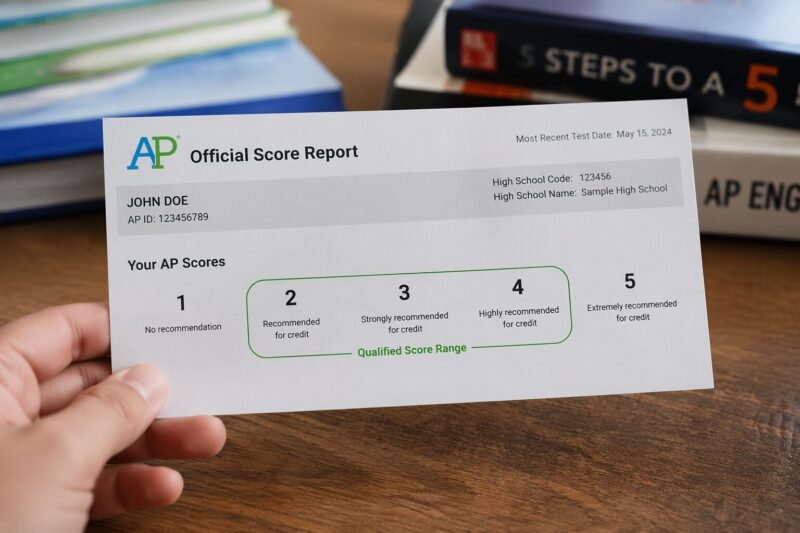
The College Board scores tests on a 1 to 5 scale. Scores of 3, 4, or 5 count as qualifying. Students often define “hard” differently than the Board. Some view it as complex content, while others see it as low pass rates. The distinction matters when choosing classes. A low pass rate does not always mean the material is impossible. It might mean fewer students are ready.
Students often confuse strict grading with impossible content. Many courses have strict rubrics but manageable material for those prepared. The hardest AP exam is often the one that surprises you. Preparation levels vary widely by high school district. This creates a wide gap in reported statistics.
Statistical Indicators of Exam Challenge
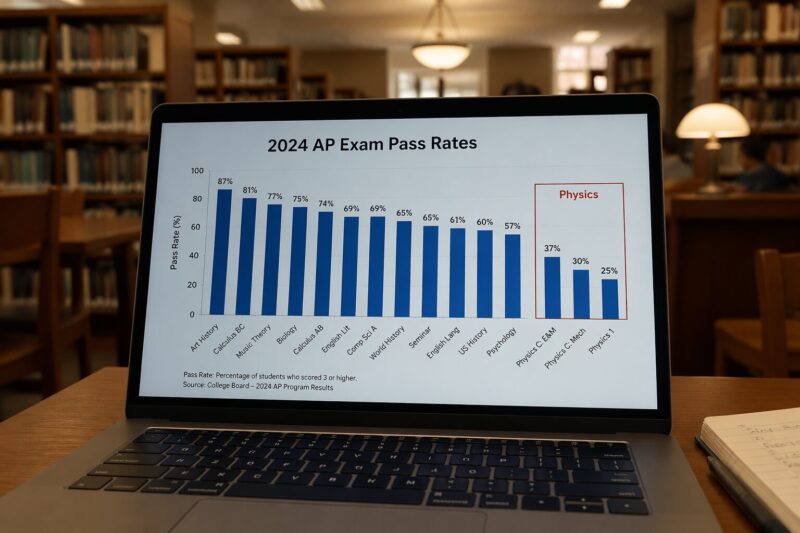
Physics 1 leads as one of the hardest exams often seeing as few as 11% of students achieving a top score. This data point appears consistently across multiple 2025-2026 reports. Best Colleges ranks this subject at the top of difficulty charts. Environmental Science and English Language and Composition frequently appear in high-difficulty rankings.
The College Board adjusts cut-off scores based on cohort data. Experts note this adjustment affects the final numbers reported each year. If a cohort performs poorly, the board might lower the bar for qualifying scores. This changes how difficulty feels to the student. A pass becomes easier for the class overall.
A report from College Prep Study notes that historically, most of the 40 AP subjects maintain pass rates between 60% and 80%. This range sets a baseline for what a standard exam looks like. Deviations from this norm usually signal a challenge. Physics 1 sits well below this average benchmark.
Niche Subjects and Specialized Skill Requirements
AP Latin and AP Music Theory feature low pass rates due to the need for years of pre-existing, specialized knowledge. Most students have not built these skills over time before high school. They rely on niche skill sets that general academic aptitude does not capture. The College Board acknowledges this in its difficulty analysis.
Identifying the divide between STEM-based challenges and humanities-based performance metrics is vital. STEM tests like Physics rely on logic and calculation. Humanities tests like Latin rely on translation and grammar mastery. Both require significant time investment outside the classroom.
Many students fail these exams because they treat them like general electives. They assume a short review period will suffice for complex content. This approach fails in subjects requiring years of immersion. You cannot cram the structure of ancient Latin in a single week.
Common Myths Regarding AP Success
Addressing the misconception that a low pass rate automatically equals a “harder” class is necessary. Just as Legacy Online School explains in their 2025 analysis, a class can have a low pass rate because it attracts underprepared students. A class can also be hard, but statistics don’t always tell the full story.
The influence of mandatory enrollment policies in some high schools can lower averages. Students taking AP Latin might not have studied the language for years. They enroll because it fits their schedule. Their presence drags down the pass rate for the specific course. This skews data against the subject.
The College Board notes that self-selection plays a role in traditional rankings. Only students who enjoy the class or are motivated do well. Those who struggle might not even take the test. These factors combine to create a distorted view of difficulty. The data reflects enrollment habits as much as subject difficulty.
Factors Affecting Your Performance Potential

Quantitative ability levels dictate why physics and math exams reward specific logical frameworks. If you struggle with spatial reasoning, Physics 1 will feel harder regardless of your math skills. Different subjects test different cognitive assets. You need to assess your own strengths before picking courses.
Language and arts background matters for niche subjects like Latin. Your prior exposure determines the steepness of the learning curve. A student with a background in ancient languages will find that path easier. Others must build that foundation from scratch during high school. This requires hours of independent study.
The relationship between historical pass rates and individual difficulty varies by student. The 60–80% historical range applies to the general population. Your personal pass rate depends on your study habits. If you follow a rigorous schedule, you can beat the average. This data point is a guide, not a verdict.
| Exam Subject | Typical Pass Rate | Perfect Score Rate | Primary Challenge |
|---|---|---|---|
| AP Physics 1 | ~47% | ~10% | Conceptual reasoning without calculus |
| AP Environmental Science | ~54% | ~9% | Broad scope and data application |
| AP Latin | ~59% | Low | Specialized grammar and translation |
| AP Calculus AB | ~80% | High | Mathematical speed and accuracy |
| AP US History | ~72% | Low | Essay volume and content recall |
Takeaways for Student Planning
Using pass rate data as a guide rather than a deterrent for course selection is wise. A low pass rate does not mean you should avoid a subject you love. You can still earn a qualifying score if you prepare well. Treat the data as a sign to invest extra time in study.
Balancing personal academic strengths against external rankings of “hardness” is important. Do not choose a class solely because it looks easy. Choose a class that fits your college goals. You might struggle in a “hard” class but succeed. You might fail in an “easy” class too.
Understanding that qualifying scores are standard across disciplines despite varying difficulty levels helps. The College Board adjusts scores to ensure a meaningful outcome. A 3 means something consistent across subjects even if the work differs. Focus on mastering the material rather than chasing a specific number.
Learning to draw a graduation cap requires precision, just as preparing for these exams does. See how to draw a perfect graduation cap. It shows that structure leads to a better result. You need structure for your AP exam prep.
My Experience With What is the hardest AP exam to pass?
I have watched countless students stress over these statistics. Some spend hours analyzing forums to find the path of least resistance. They pick their classes based on what others say is easy. I think they ignore the real goal of learning.
One student in my circle failed AP Physics 1 on his first try. He thought he was ready because he liked math. He forgot how much conceptual reasoning the exam requires. He failed because he tried to memorize formulas instead of understanding them. It took him a semester to pass on his second attempt.
We often think hard classes are just about the content. Sometimes they are about the mindset. The hardest AP exam is the one you are not prepared for. Even if the class is rated 50th in difficulty rankings. You need to know your own limits and study habits. It is better to fail early and learn.
Have you ever struggled with an exam you thought would be easy?
FAQ
Q: Are AP Latin and Music Theory very difficult?
Answer: Yes, AP Latin and AP Music Theory are consistently ranked as the hardest AP classes by College Raptor based on pass rates. AP Latin has a 59% pass rate, while Music Theory has a 60% pass rate, both requiring mastery of complex ancient grammar or abstract musical concepts.
Q: How does AP US History compare in difficulty?
Answer: AP US History is one of the hardest humanities exams with a 72.2% pass rate, the third-lowest among all courses. Despite being popular with nearly 489,000 students taking it, only 12.8% score a 5. The volume of material to memorize is a major factor here.
Q: What makes AP Chemistry a tough exam?
Answer: AP Chemistry is a close runner-up to Physics 1 in difficulty, with a pass rate below 60%. It requires deep understanding of complex chemical concepts and precise problem-solving skills that many students find challenging. The curriculum demands high precision in lab work.
Q: Will AP Human Geography be hard for beginners?
Answer: AP Human Geography is difficult for beginners with only a 56% pass rate. While 18% of those who pass score a 5, the exam requires memorizing extensive geographic data and understanding complex spatial relationships. It combines social science concepts with detailed knowledge.
Q: Is AP Statistics harder than AP Calculus AB?
Answer: AP Statistics is considered harder among math APs with a 62% pass rate, whereas AP Calculus AB has a higher pass rate. However, AP Computer Science Principles has the lowest percentage of 5 scores at only 11%. Programming concepts often confuse students new to the subject.
Q: Which AP exam has the lowest percentage of 5s?
Answer: AP Physics 1 has one of the lowest percentages of students scoring a 5 at just 10.2%. AP Environmental Science is even lower at 9.2%, making it extremely difficult to achieve a perfect score on these exams. These scores often surprise families expecting them to be higher.
Q: What are the top 5 hardest AP classes overall?
Answer: The top five hardest AP classes are AP Physics 1, AP Environmental Science, AP English Language and Composition, AP Human Geography, and AP Latin. These exams consistently have the lowest pass rates and perfect score percentages across all AP courses.
Latest Updates
Recent data from the 2025-2026 cycle shows slight shifts in pass rate trends for popular subjects. AP Computer Science Principles continues to challenge students with new coding requirements. The College Board updated some exam sections to better reflect modern learning environments. Statistics suggest that students performing well in 2024 saw consistent improvement in 2025.
Conclusion
Choosing which AP classes to take is a balance of personal strength and external data. You now have the facts needed to make an informed decision. Avoid letting pass rates dictate your interest. Your success depends on your effort and preparation. Use these rankings to plan your study time, not to limit your options. You can succeed in the hardest AP class if you stay focused.
References
- Legacy Online School. (2026, April 27). Ranking the Harshest and Easiest AP Classes and Exams for 2025. Legacy Online School. https://legacyonlineschool.com/blog/ranking-the-hardest-and-easiest-ap-classes-and-exams-for-2025.html
- Best Colleges. (n.d.). What Are the Hardest AP Classes and Tests? BestColleges. https://www.bestcolleges.com/blog/hardest-ap-classes
- College Prep Study. (2023). What Are AP Exam Pass Rates? College Prep Study. https://collegeprep.study.com/ap/what-are-ap-exam-pass-rates.html

A Teacher with 5 years of experience. Our Expertise, is reliable to meet your full Academic development needs . Worked on many crafts and construction projects offering services from design to development to deployment over the years. You will find many of my works in my business portfolio on request.