



What makes a truly great 14-day journaling challenge stand out from every other self-discovery exercise or personal history reflection you’ve tried? This structured program uses short daily prompts to build a lasting writing habit. Whether you want to calm your nervous system this spring or track emotions during the busy holiday season, consistency matters more than duration. Research shows regular writing lowers cortisol and stabilizes mood. You can pick from beginner sessions, gratitude lists, or scholarly accountability tracks to match your current goals. Here is how the challenge actually works behind the scenes.
Quick Questions and Answers
Question: What is a 14-day journaling challenge? Answer: A 14-day journaling challenge is a time-bound, structured program designed to help participants write daily for exactly two weeks. Platforms define it primarily as a tool to build a sustainable journaling habit through consistent, low-friction practice. The structure usually relies on daily prompts to guide reflection, making the process manageable while encouraging users to explore personal experiences without facing blank-page pressure.
Question: Why do people do a 14-day journaling challenge? Answer: Participants choose this format to kickstart a new habit by reducing daily friction through a fixed two-week window. Many seek emotional clarity or mindfulness by using guided self-reflection exercises. Others join academic or professional versions focused on scholarly accountability. Regardless of the category, users generally report that the defined timeframe keeps them committed longer than unstructured note-taking ever could.
Question: Can journaling for 14 days actually help? Answer: Evidence supports the effectiveness of this approach for both mental health and productivity. Research indicates that putting pen to paper lowers cortisol levels, calms amygdala activity, and strengthens emotion regulation pathways in the brain. Additionally, data from professional writing organizations shows that nearly all participants find the structured format highly beneficial for making tangible progress on their personal or academic goals over just fourteen days.
Key Takeaways
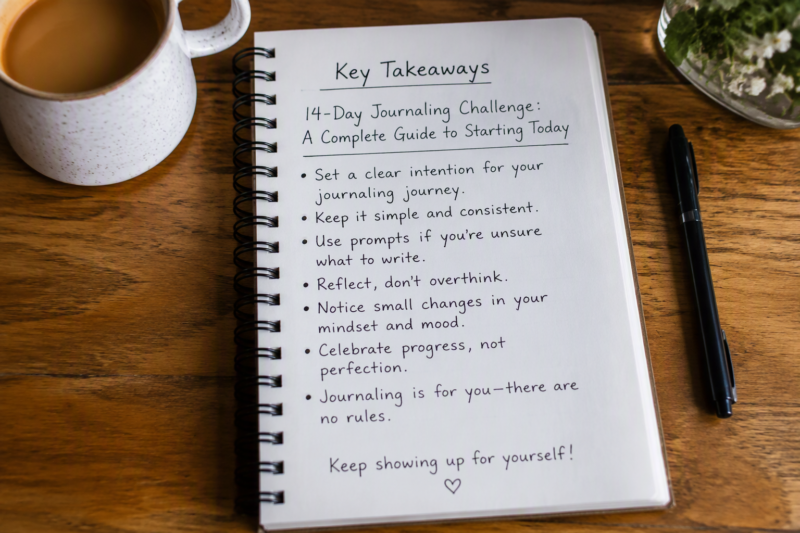
- Consistency beats duration: Fourteen days is short enough to prevent burnout yet long enough to establish neural pathways for a new routine.
- Science-backed regulation: Regular writing actively reduces cortisol and improves how the brain processes emotional memories.
- Flexible categorization: You can select beginner habits, reflective history, or output-focused accountability models based entirely on what you need right now.
14-Day Journaling Challenge: Core Concepts and Psychological Benefits
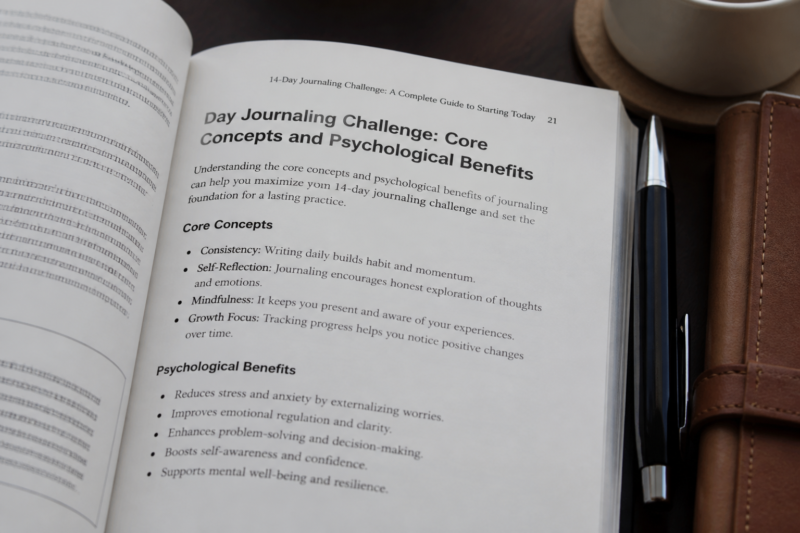
Hundreds of studies show that putting pen to paper changes how your brain works. Tara Schuster notes that regular writing lowers cortisol, calms the amygdala, and boosts activity in regions responsible for emotion and memory regulation. The physiological shift happens because writing engages language centers that override the stress response. You move reactive energy into structured thought. The prefrontal cortex takes the wheel. You get better at naming feelings and less swept up by them.
The challenge creates a container for this effect. You commit to two weeks instead of forever. That reduces the mental weight immediately. Day One defines this model explicitly. They call it a program designed to cultivate a habit rather than just record events. The two-week sprint aligns with how the brain forms initial loops. You get early momentum that motivates continuation. Susie Rinehart emphasizes that the best version has no rules. Sessions run between one and eleven minutes each morning. You simply start whenever you start. The lack of constraints stops perfectionism from blocking progress. You write messy drafts. You skip punctuation. The goal remains building the daily loop.
Habit Formation and Time Commitments
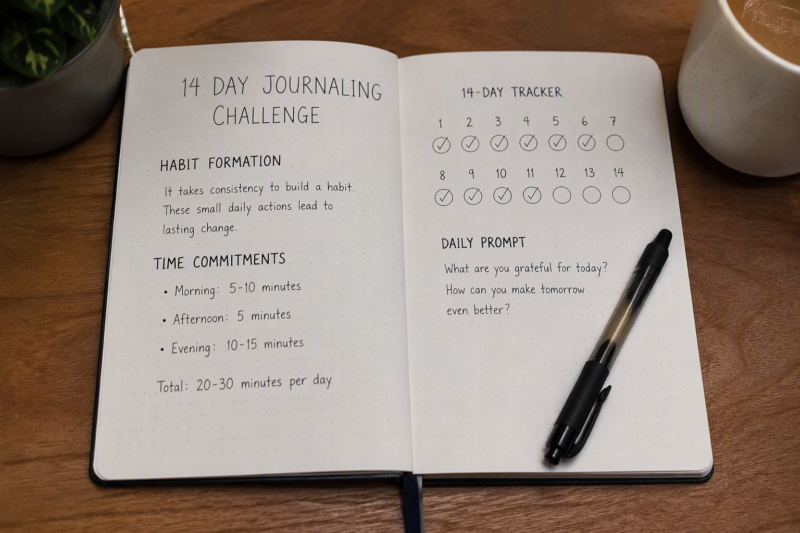
Duration varies wildly across different programs. Susie Rinehart’s method targets the micro-habit crowd. She recommends just one to eleven minutes of free-writing. This works well for mornings when energy is low. Your hand moves, the streak stays alive. Morning rituals capitalize on willpower peaks. Setting the journal by your coffee maker creates a physical trigger. Waking up signals the prompt. The behavior sticks faster when tied to an existing cue.
Bluoum offers a slightly longer window. Their self-discovery challenge asks for ten to fifteen minutes daily. The structure is loose. Participants can move through prompts in any order they prefer. Days where you feel stuck still yield value if you spend the full quarter-hour writing. Evening sessions work better for processing daily clutter. You dump the mental debris and sleep easier. Timing flexibility exists across most formats.
Academic tracks demand serious commitment. NCFDD requires thirty minutes minimum every single day. Participants log into a community timer and report back. The math adds up fast. Average writers complete around three hundred and fifty minutes across the fourteen days. That equals roughly five hours and fifty minutes of deep work. Switching mediums occasionally keeps things fresh. Exploring techniques like those in our guide on art journal therapy can make the physical act of creation feel even more freeing. The choice depends on whether you want maintenance or a heavy workout.
Popular Categories and Structural Frameworks
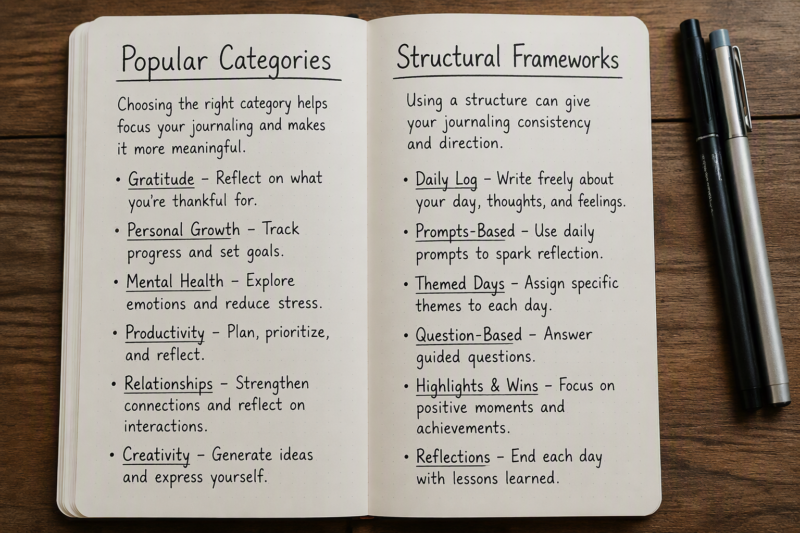
Most platforms organize these challenges into distinct flavors. Beginner tracks prioritize gentle entry. Day One sends daily email prompts. You answer one question per day in your app. The sequence builds familiarity slowly. Users report feeling less overwhelmed compared to starting a blank notebook cold turkey. Decision fatigue vanishes. You wake up, check email, and write. No guessing required.
Personal history routes dig deeper. This framework guides you through autobiographical terrain. Prompts pull you from earliest memories forward to major turning-point moments. You map out how early experiences shaped current behaviors. The narrative thread connects childhood to adulthood. You end up seeing patterns you missed before. Identity coherence improves as you connect the dots.
Accountability frameworks shift focus to output. NCFDD treats the challenge as a professional sprint. Members post updates in a shared feed. They comment on peers’ milestones. The social contract raises the stakes. Writing becomes a group effort. Breaking a promise to a peer hurts more than breaking a promise to yourself. Social facilitation drives productivity.
| Category | Structure | Daily Time | Primary Goal |
|---|---|---|---|
| Beginner | Email prompts | 5–10 min | Build basic habit |
| Personal History | Narrative prompts | 10–15 min | Understand life patterns |
| Scholarly | Community timer | 30+ min | Create finished work |
| Free-Write | No rules | 1–11 min | Lower resistance |
Effective Prompting Techniques
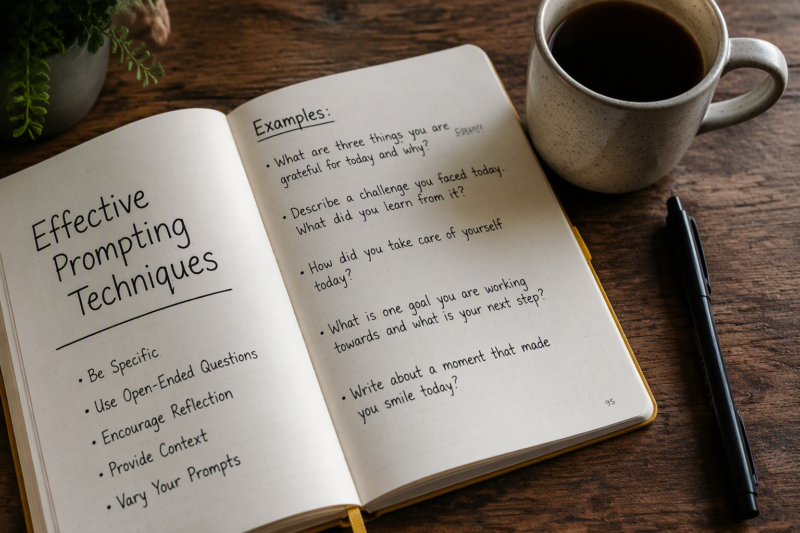
Prompts dictate the quality of reflection. Good ones force specificity. Blank pages trigger anxiety. Structured questions bypass the freeze response. Reflection prompts ask about current dilemmas. You write down the problems you are living with right now. The instruction gives permission to leave them unanswered. Naming the confusion drains some of its power. You document the state of play without needing a solution immediately.
Emotional processing exercises tackle complex feelings head-on. Try combining opposing emotions in one sentence using the connector “AND”. Write “I feel totally overwhelmed AND deeply grateful.” This technique validates conflicting states simultaneously. It prevents binary thinking. Your brain accepts nuance faster when forced to hold two truths at once. Cognitive rigidity melts under this pressure.
Gratitude lists ground the practice in positivity. Aim for five to ten concrete items each day. Skip vague compliments. List the neighbor who waved, the coffee that hit right, the quiet train car. Specificity anchors the mood lift. Vague statements fail to trigger dopamine. Forward-looking prompts project you further. Before you close the book, experiment with mixing media. Drawing lines can reset a stubborn mind. Check out our list of art sketch ideas to spark your imagination and bring fresh energy to your session.
Visionary prompts cast a net toward the future. Draft a letter to yourself six months down the line. Describe the goals you hope to crush. Set expectations for the person you plan to become. Reading that letter later provides a powerful reality check on growth trajectories. Sensory awareness exercises return you to the present. Notice texture, smell, and sound. Rumination dies when attention lands on external stimuli.
Practical Differences: Personal vs. Professional Writing
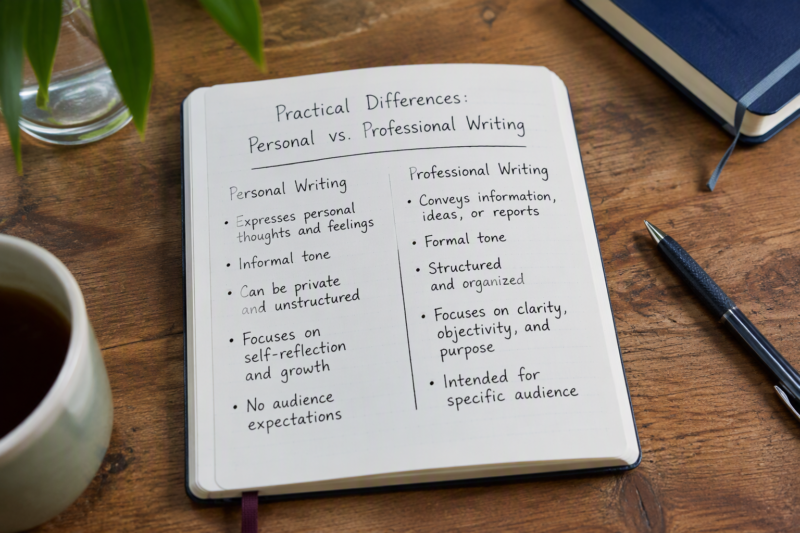
The intent separates personal journals from professional sprints. Personal challenges prioritize internal state over external results. You care about emotional release and mindfulness. The output stays private. Success means showing up for yourself. You build resilience and self-awareness. The reward is internal peace.
Professional tracks redefine writing as deliverable generation. According to the National Center for Faculty Development & Diversity, structured writing challenges significantly improve academic productivity. NCFDD counts grant proposals, draft chapters, and exhibit concepts as valid writing sessions. The barrier shifts from “should I feel inspired” to “can I produce text.” Results matter more than mood.
Numbers prove the model works for academics too. Nearly ninety-eight percent of recent participants said the structure helped them advance their projects. The combination of time-tracking and peer support removes isolation. Writing a dissertation alone becomes a team sport. Transfer effects emerge naturally. Professional wins bleed into personal confidence. Finishing a grant abstract proves discipline. That confidence spills back to journaling. Personal resilience helps tackle hard writing tasks. The loop reinforces both sides. Structure converts anxiety into motion.
FAQ
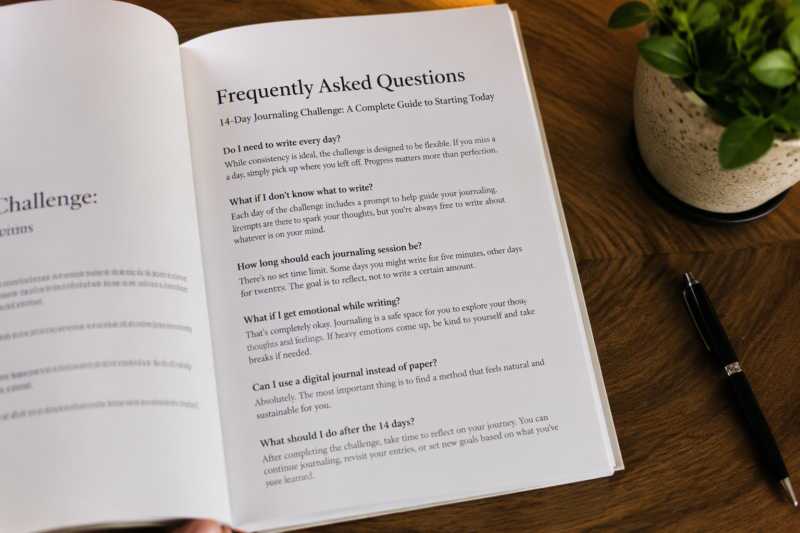
Q: How long should each journaling session be?
Duration depends entirely on the specific program you select. Some free-writing methods require only one to eleven minutes. Others recommend ten to fifteen minutes for deeper reflection. Academic versions demand thirty minutes minimum. NCFDD tracks these longer blocks rigorously. Match the time commitment to your current schedule. Short sessions sustain habits during chaotic weeks. Long blocks drive major output when you have downtime. Choose based on whether you need maintenance or a heavy workout.
Q: What should I write about during the challenge?
Topics range widely across different formats. You might construct a gratitude list with five to ten items. You could draft a letter to your future self. Some prompts invite you to name opposing emotions or solve current questions. Day One adapts themes to either beginner basics or deep personal history exploration. Pick directions that align with your immediate goals. If you need calm, choose sensory exercises. If you need progress, pick accountability tracks.
Q: Is a 14-day journaling challenge good for beginners?
These programs excel at lowering the entry barrier. Day One explicitly designs a beginner version that introduces journaling mechanics through simple daily prompts. Susie Rinehart’s approach requires no artistic skill or literary talent. She encourages pure free-writing with zero grammar enforcement. Beginners benefit most from the built-in structure. You learn the rhythm of daily writing without worrying about format. The guided nature prevents early abandonment caused by uncertainty.
Q: What are the drawbacks of journaling every day?
Daily commitments can trigger fatigue or guilt if you miss a day. Highly demanding prompts sometimes turn relaxation into another chore. You might feel pressured to produce profound insights every morning. Most programs counter this by offering short sessions or flexible sequencing. Resuming after a slip is usually encouraged rather than punished. The cumulative benefit outweighs occasional skips. Treat gaps as part of the learning curve instead of failures.
Q: What are the main categories of journaling challenges?
Organizers split challenges into distinct buckets. You will find beginner habit-builders, personal history explorers, and self-discovery trackers. Gratitude logs and sensory reflections form another common grouping. Scholarly writing challenges target professional output and grant completion. Each category differs in prompt density and expected outcome. Match your choice to your desired result. Seek emotional relief? Pick reflection. Want a finished paper? Pick accountability.
Q: How is a journaling challenge different from writing in a diary?
A standard diary captures daily happenings in unstructured form. A challenge imposes design. It sets a fixed date range and supplies specific prompts. Day One frames the model as a deliberate habit-building intervention. Diaries often drift into repetitive venting. Challenges force novelty through varied questioning. The added framework generates deeper insights and accelerates pattern recognition faster than passive recording ever could.
Q: Where can I find a trustworthy 14-day journaling challenge?
Reputable options come from established platforms and educational groups. Day One publishes structured tracks with clear instructions. NCFDD runs rigorous programs backed by organizational data. Independent educators like Susie Rinehart offer accessible, rule-free alternatives. Look for descriptions that specify time expectations and intended outcomes. Transparent programs tell you exactly what skills you gain. Avoid vague promises of overnight transformation and stick to sources with proven track records.
My Experience With 14-Day Journaling Challenge: A Complete Guide to Starting Today
I spent years fighting blank-page paralysis until I treated journaling like a lab experiment rather than a sacred ritual. The first few days felt mechanical. I typed nonsense about traffic jams and grocery lists. My handwriting looked like a toddler traced letters with a crayon. Then something shifted. By day nine, I caught myself narrating my reactions to minor annoyances before exploding. The habit gave me a pause button I never knew I lacked.
I tracked my mood alongside the text. Patterns emerged I’d been blind to. I noticed I drained my energy avoiding one specific conversation for months. Writing it down stripped the monster of its teeth. The real magic happens when you stop trying to write beautifully and start writing honestly. Clarity comes from the struggle to put fuzzy thoughts into rigid syntax. That friction forces precision. You realize what you actually believe versus what you think you should believe.
I once wrote a whole paragraph about why my cat judged my life choices. It was terrible. It was also exactly what I needed to hear about my own perfectionism. Laughter breaks tension faster than any meditation bell. Now I keep the journal open on my desk. Even five minutes resets my brain. Did you find your own breakthrough around day seven, or did the real shift catch you off guard later?