


Beading patterns range from simple stringing projects to intricate stitched designs that test your patience and precision. Whether you want to make gifts for upcoming holidays, create wearable jewelry, or just explore a new craft, finding the right starting point matters. The patterns you choose should match your current skill level, available materials, and the time you’re willing to invest. This guide walks you through 10 distinct pattern types and resources that beginners actually use to launch their beading journey.
Quick Questions and Answers
Question: What are the best bead crafts patterns for beginners? Beginner-friendly bead crafts patterns are usually simple bracelets, earrings, and basic stitched motifs that use clear step-by-step instructions. Gathered’s roundup is explicitly aimed at beginners with 23 patterns, and The Spruce Crafts also curates 9 accessible projects, which suggests there are many entry-level options to choose from.
Question: How many free beading patterns can I find online? You can find large curated collections online rather than only single tutorials. For example, Gathered lists 23 beginner patterns, The Spruce Crafts highlights 9 free projects, and another Spruce Crafts roundup includes 11 free beadwork patterns for beginners and experts.
Question: Are seed bead patterns different from regular beading patterns? Yes. Seed bead patterns usually focus on small uniform beads and stitched construction methods such as peyote stitch, while broader beading patterns may include mixed bead sizes and jewelry assembly. Interweave and The Bead Mix both provide seed-bead-specific pattern collections, showing that this is a distinct subcategory.
1. Interweave’s Free Pattern Hub
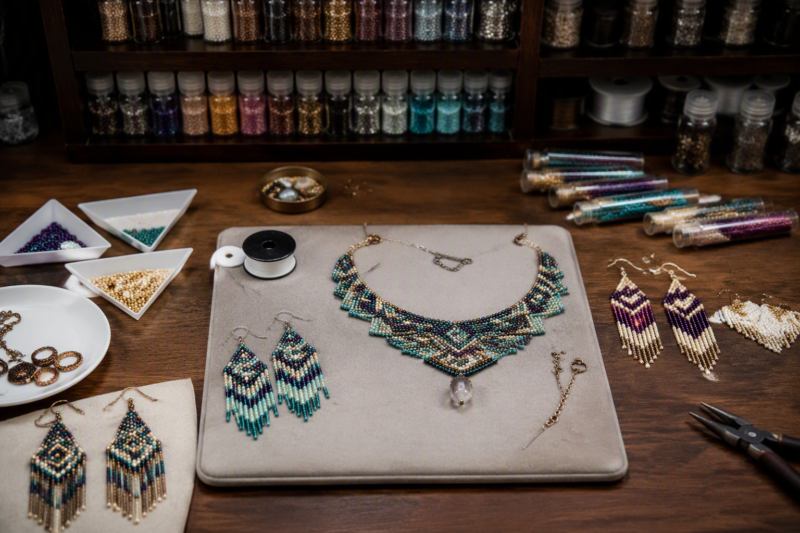
Interweave operates one of the web’s largest collections of free beading patterns, organized by project type rather than cramped into a single tutorial. You’ll find necklaces, bracelets, earrings, and stitch-based beadwork all in one place. The hub lets you compare different styles before you commit to materials or time.
This approach is especially useful if you’re unsure what kind of beading appeals to you. Rather than downloading one PDF and hoping it fits your skill level, you can browse multiple options and see which project speaks to you. According to Interweave, the hub pulls patterns from their magazines and designers, so you’re getting content that’s been tested and published professionally.
The real value here is discovery. You might go in looking for a simple bracelet and stumble across a seed bead earring pattern that sounds more interesting. That flexibility is golden when you’re new to beading.
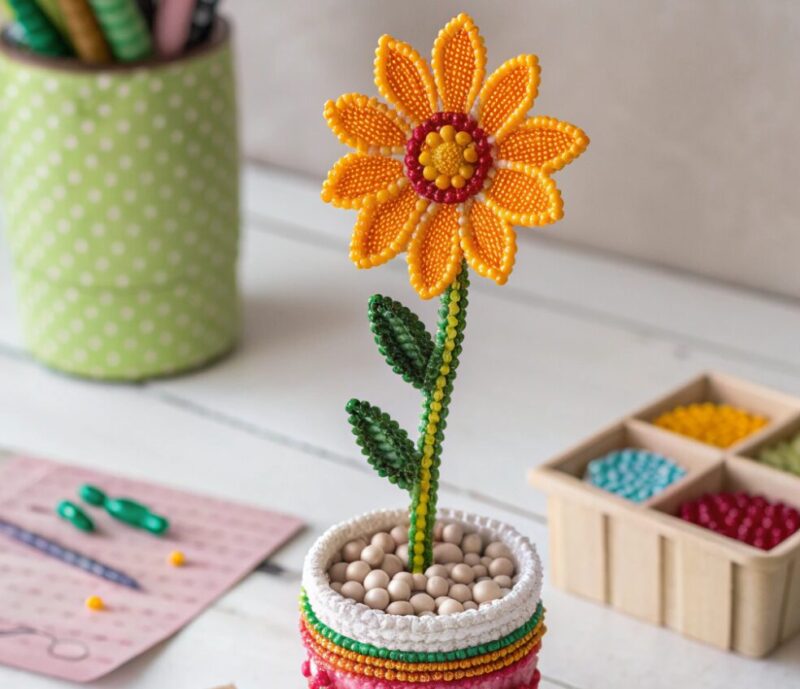
2. Beaded Flower Motif with Petal Assembly
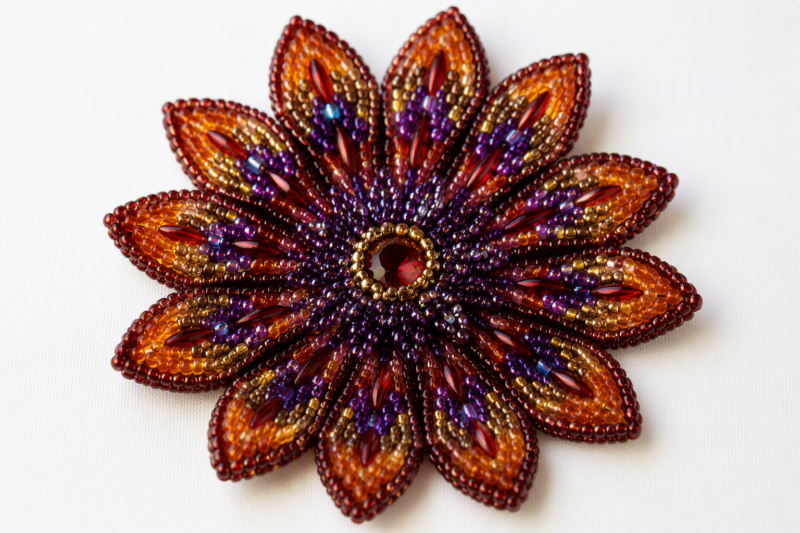
This is where beading gets structured and a little more demanding. The flower motif pattern requires you to string at least 24 inches of beads as your base material, then repeat specific steps to build 10 additional petals—meaning 11 total petals for one complete flower. It’s modular beadwork at its finest.
What makes this pattern worth trying is that it teaches repetition and consistency. Each petal needs to match the others, so you’re developing an eye for symmetry and precision. Once you’ve made one petal, you understand the rhythm, which speeds up the work. The Interweave bead craft sampler walks you through this with exact measurements, so there’s no guessing involved.
This pattern works best after you’ve tried at least one or two simpler projects. You need to be comfortable with basic stringing before tackling the petal assembly.
3. Gathered’s 23-Pattern Beginner Roundup
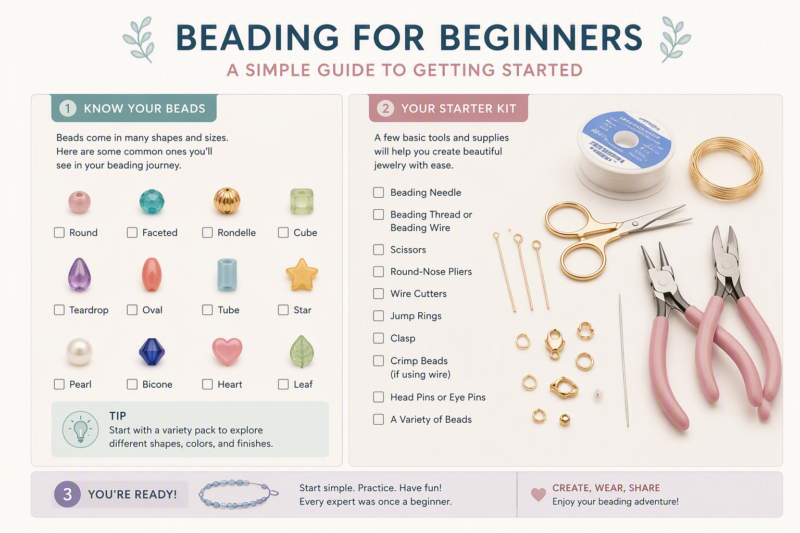
Gathered curates 23 distinct beading patterns specifically for newcomers. That’s a substantial starter library—enough variety that you can match a pattern to whatever mood or materials you have available on a given day.
The breadth matters here. Some of those 23 patterns will be bracelet-focused, others earrings, some necklaces. A few might use stitching techniques. That range means you’re not locked into one approach. If you find a pattern that doesn’t click, you have 22 other options waiting.
Gathered’s collection is specifically designed to help beginners avoid feeling overwhelmed. The patterns are grouped so you can scan them and find something that matches your confidence level and the materials you already own. That’s practical curation, not just throwing 23 links at you and hoping something sticks.
4. The Spruce Crafts’ 9 Style-Focused Projects

The Spruce Crafts takes a different angle than Gathered. Instead of maximizing the number of patterns, they curate just 9 projects but frame each one around wearable, giftable outcomes. These are patterns designed to produce something you’d actually want to wear or give away, not just practice pieces.
The focus on style and finished appearance appeals to people who care about the end result as much as the learning process. If you’re making something for a birthday or holiday, this collection hones in on projects that look polished and intentional.
Each project in the roundup includes difficulty notes, so you know which ones are suitable for your current level. The projects span accessories—bracelets, necklaces, earrings—so there’s enough variety without the analysis paralysis that comes with browsing 100 options.
5. The Bead Mix Seed Bead Library
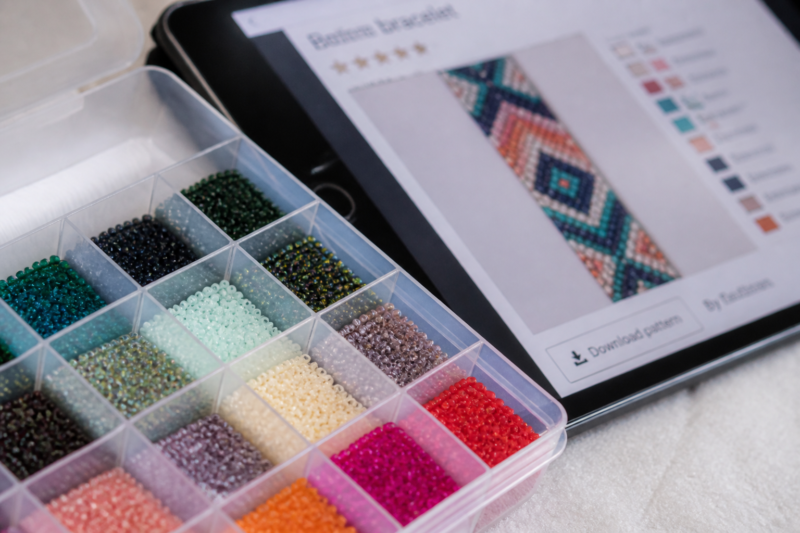
Seed beads are small, uniform, and incredibly versatile. The Bead Mix maintains a dedicated library of patterns that focus exclusively on seed beads rather than mixing multiple bead sizes. This specialization matters because seed bead patterns use different techniques and stitching methods than general beadwork.
If you’re drawn to the idea of creating intricate, geometric beadwork using tiny uniform beads, the Seed Bead library is where you start. The patterns here are downloadable, which means you can print them and work offline—handy if you’re beading in a waiting room or on a train.
The downside? Seed bead work requires more precision and patience than some other beading types. Your eyes need to track small beads and fine thread. If you’ve got steady hands and good lighting, though, seed bead patterns deliver some of the most satisfying geometric results in beading.
6. Flat Peyote Stitch Patterns
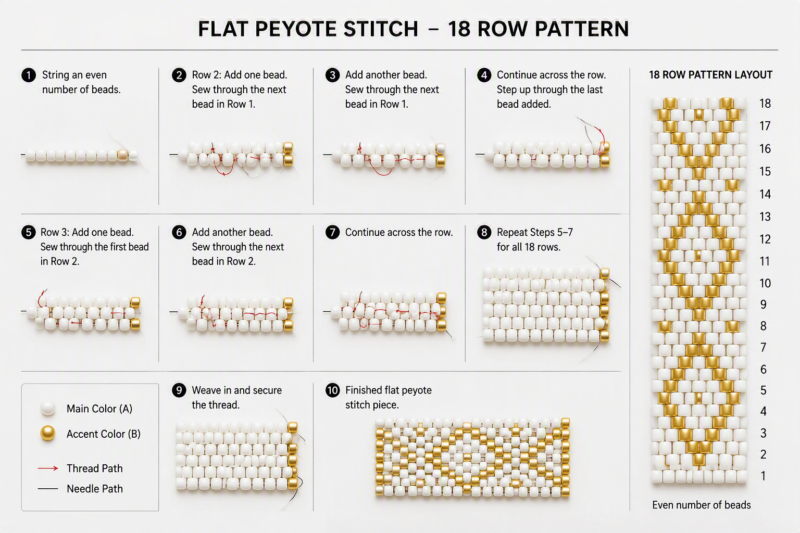
Peyote stitch is one of the most common stitching methods in beading, and flat peyote is where most people start with stitch-based work. The technique involves building a foundation row, then “stepping up” to create additional rows in an offset pattern that naturally creates a flat, textured surface.
A typical flat peyote pattern might specify working 18 rows to establish your foundation. That’s precise, counted work—no improvisation. You need to keep track of your bead count and make sure each row aligns correctly with the row below it. It’s methodical, and that precision is exactly what appeals to people who like structure.
Interweave’s seed bead PDF includes flat peyote examples with exact row counts and instructions. Once you understand the stepping-up motion, you can apply peyote stitch to all kinds of projects—bracelets, pendants, even small sculptural pieces.
7. Beadaholique’s Technique-Organized Catalog
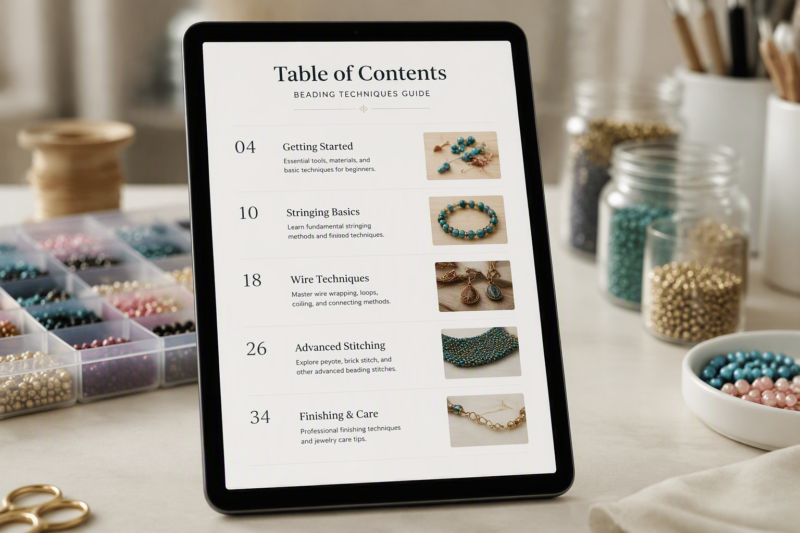
Beadaholique organizes free beading patterns as a searchable table of contents rather than a linear list. You filter by technique—stringing, peyote stitch, right-angle weave, brick stitch—and drill down into patterns that use the method you want to learn.
This structure is especially useful once you’ve completed a few beginner projects and want to level up to a specific technique. Instead of browsing through everything, you can jump directly to “loom weaving patterns” or “pearl stringing projects.” The organization respects your growing expertise.
For beginners, the catalog approach can feel overwhelming at first. There are a lot of technique names and categories. But that overwhelm disappears once you try one stitch and want to explore variations on it. Then the catalog becomes a navigation tool rather than a barrier.
8. The Spruce Crafts’ 11-Pattern Expert-Friendly Collection
The Spruce Crafts publishes a broader roundup of 11 free beadwork patterns that span the gap between beginner and expert skill levels. This collection is structured around difficulty ratings, so you can start with foundational projects and work your way up to more complex designs without hunting for new resources.
The advantage here is continuity. As you grow as a beader, you can return to the same resource and find the next challenge waiting. You’re not constantly searching for new collections—you can progress within one trusted roundup.
The patterns in this collection reflect a wider range of techniques and styles than the 9-project list. You’ll encounter different bead types, different assembly methods, and different finishing techniques. That breadth prepares you for the many directions beading can take.
9. Dimensional Leaf-and-Flower Assembly Projects
Some patterns combine multiple components into one finished piece. A dimensional flower design might require you to create 8 individual leaves using one stitching technique, then stitch those leaves around a central flower base created using a different method. It’s modular assembly at a higher level of complexity.
These patterns teach you how to think compositionally about beadwork. You’re not just making one shape; you’re building a three-dimensional structure from separate components. That skill transfers to all kinds of beadwork, from sculptural pieces to structured jewelry.
The payoff is striking. When you step back and see those 8 leaves arranged around the flower core, the complexity disappears. What remains is a beautiful, intricate finished object. That’s what keeps people beading.
10. Free Downloadable PDF Samplers
Several pattern sources—Interweave especially—offer freemium PDF samplers that bundle multiple patterns into one downloadable file. These PDFs give you exact material counts, step-by-step photo sequences, and assembly instructions all in one document. No need to juggle multiple browser tabs or hunt for clarification.
The PDF format also means you can print the pattern and work from paper rather than squinting at your phone. Some beaders swear by this approach. Paper patterns reduce screen time and let you annotate directly on the pages—checking off steps as you complete them or jotting down notes about bead colors or spacing.
The trade-off is that PDFs are static. If you need real-time help or want to ask a question, you’re not in an online community. But for straightforward patterns with clear instructions, that’s not usually a problem.
Comparison of Pattern Types and Best Uses
| Pattern Type | Best Skill Level | Time Commitment | Material Investment | Key Technique |
|---|---|---|---|---|
| Simple stringing | Beginner | 1-2 hours | Low | Basic threading |
| Seed bead collection | Beginner to intermediate | 3-8 hours | Low to moderate | Off-loom stitching |
| Peyote stitch foundation | Intermediate | 4-6 hours | Moderate | Counted stitch work |
| Flower motif assembly | Intermediate | 5-10 hours | Moderate | Multi-component assembly |
| Dimensional leaf design | Advanced | 8-15 hours | Moderate to high | Complex 3D assembly |
Common Mistakes Beginners Make
Rushing through the material-counting phase is the first trap. You might think a few beads off here or there won’t matter, but when you’re working peyote stitch or any counted technique, even one missed bead throws off the entire row. Take the time to count carefully. Use a small bowl to portion out beads before you thread them.
Choosing patterns with thread that’s too thick for your beads is another classic error. If the thread barely fits through the bead hole, you’ve got a problem. The beads won’t sit flush, your tension will be all over the place, and the finished piece looks messy. Match your thread weight to your bead size. Seed beads usually need thread that’s much finer than you’d expect.
Skipping the step where you test your pattern with sample beads costs people time. If a pattern calls for a specific bead type and you substitute something “close enough,” the entire proportion and feel of the finished piece changes. Spend a few minutes verifying that the beads you have match what the pattern specifies.
Not anchoring your thread properly at the start leads to unraveling. A secure knot and a few passes through nearby beads keeps your work from falling apart if the thread gets tugged. Beginners often skimp on this. Don’t.
My Experience With 10 Brilliant Beaded Craft Patterns for Beginners
I started beading thinking it would be mindless meditation. I was half right. Simple stringing projects are genuinely calming, but the moment I tried flat peyote stitch, I learned that beading demands focus. Dropped a bead in the middle of row twelve? You’re starting over. That taught me respect for precision work.
The Gathered collection was a lifesaver when I was hunting for my second project. I didn’t want to commit to a massive time investment or complex technique—I just wanted something that looked slightly more sophisticated than my first bracelet. Having 23 options meant I could skim through and find a project that matched my exact mood that day.
What surprised me most was how much the pattern source matters. A well-written PDF from Interweave walks you through every step with exact bead counts and photo sequences. A vague tutorial from a random blog leaves you guessing and frustrated. Not all patterns are created equal, and beginners do themselves a favor by starting with curated collections from established publishers.
The real breakthrough happened when I understood that different stitch techniques unlock completely different design possibilities. Stringing gives you simple linear projects. Peyote stitch lets you build texture and dimension. Once I grasped that connection, I stopped seeing beading as one monolithic skill and started seeing it as a toolkit where each technique opens new doors.
What patterns are calling to you right now? Are you drawn to the simplicity of stringing, or does the precision of counted stitch work appeal to your brain?
FAQ
Q: What beading stitch is easiest for new crafters?
Flat peyote stitch is one of the most common beginner-friendly stitch patterns because it appears frequently in instructional beadwork resources. The stitch uses a simple stepping-up motion that, once you understand it, becomes automatic. Resources like Interweave’s seed bead PDF include flat peyote examples with 18 rows, showing that it’s a standard stitch used in structured patterns for newcomers.
Q: Can I make jewelry with bead craft patterns?
Yes. Many bead craft pattern collections are jewelry-oriented, especially bracelets, necklaces, and earrings. Both Interweave’s free-pattern hub and The Spruce Crafts’ project roundups are designed around wearable beadwork and style-focused projects. That means you’re not just learning technique—you’re building pieces you can actually wear or gift.
Q: Do bead patterns tell you exactly what to do?
Well-written bead patterns usually give step-by-step instructions, material counts, and assembly directions. Interweave’s sample instructions, for example, specify stringing at least 24 inches of beads, making 10 additional petals, and attaching 8 leaves to the flower base. The level of detail varies, though. Print-quality PDFs tend to be clearer than online tutorials.
Q: Which bead craft patterns are good for gifts?
Small jewelry items and decorative motifs are often best for gifts because they’re quick to complete and easy to customize. The Spruce Crafts’ style-focused project roundups are a good place to look for giftable beadwork, especially if you want wearable items rather than large decorative pieces. A beaded bracelet or pair of earrings makes a thoughtful handmade gift.
Q: How do I choose the right beading pattern?
Choose by skill level, bead type, and project size. Beginner-curated lists like Gathered’s 23 patterns and The Spruce Crafts’ 9-project roundup are good for simple starts, while Interweave’s stitch-heavy PDFs are better if you want structured, counted beadwork. Start with a pattern that matches where you are now, not where you want to be in six months.
Q: What tools do I need for bead crafts patterns?
Most bead craft patterns require beads, thread or wire, a needle suited to the bead size, and sometimes clasps or findings for jewelry. The exact tools depend on the pattern—a simple stringing project needs almost nothing beyond beads and thread, while stitch-based projects like Interweave’s examples often require careful threading materials and repeated component assembly. A bead board helps you organize beads before you start.
Q: Why do some bead patterns look hard to follow?
Some patterns are hard to follow because they rely on precise counts, repeated stitches, and assembly steps rather than simple stringing. Interweave’s examples show this clearly with instructions such as 18 rows of peyote stitch, multiple petals, and attached leaves, which can be challenging for first-time makers. Look for patterns with photos or diagrams in addition to written instructions—they’re much easier to follow.
Conclusion
Beading patterns exist for every skill level, from the absolute beginner to the seasoned expert. The key is finding resources that match where you are right now and offer clear pathways to the next level. Gathered’s 23 beginner patterns, Interweave’s organized hub, and The Spruce Crafts’ curated collections all serve different purposes, but they share one thing: they make it easy to start.
Your first pattern matters less than your willingness to try. Pick something that excites you, even if it looks slightly intimidating. String a simple bracelet if that’s where your confidence sits. Try a peyote stitch flower if you’re ready for structure and counting. Take your time, count your beads carefully, and remember that every master beader started exactly where you are—holding a needle and wondering if they could actually pull this off.
They did. You will too. Pick a pattern and get started.
References
- Interweave. (n.d.). Free Beading Patterns You Have to Try. Interweave. https://www.interweave.com/free-beading-patterns/
- Interweave. (n.d.). Free Bead Craft Patterns. Interweave. https://www.interweave.com/wp-content/uploads/BeadCrafts-freemium.pdf
- Gathered. (n.d.). 23 beading patterns for beginners. Gathered. https://www.gathered.how/arts-crafts/beading-patterns
- The Spruce Crafts. (n.d.). 9 Fun Beading Projects to Keep You Busy and In Style. The Spruce Crafts. https://www.thesprucecrafts.com/free-beading-patterns-4118327
- The Bead Mix. (n.d.). Free Seed Bead Patterns. The Bead Mix. https://www.thebeadmix.com/pages/free-seed-bead-patterns
- Interweave. (n.d.). Beading Daily’s Favorite Beading Stitches and Beadwork Techniques. Interweave. https://www.interweave.com/wp-content/uploads/5-Free-Seed-Bead-Patterns.pdf
- Beadaholique. (n.d.). Table of Contents: Free Beading Patterns. Beadaholique. https://beadaholique.com/blogs/techniques-guides/table-of-contents-free-beading-patterns
- The Spruce Crafts. (n.d.). 11 Free Beadwork Patterns for Beginners and Experts. The Spruce Crafts. https://www.thesprucecrafts.com/free-beadwork-patterns-to-download-now-4105964

A Teacher with 5 years of experience. Our Expertise, is reliable to meet your full Academic development needs . Worked on many crafts and construction projects offering services from design to development to deployment over the years. You will find many of my works in my business portfolio on request.