
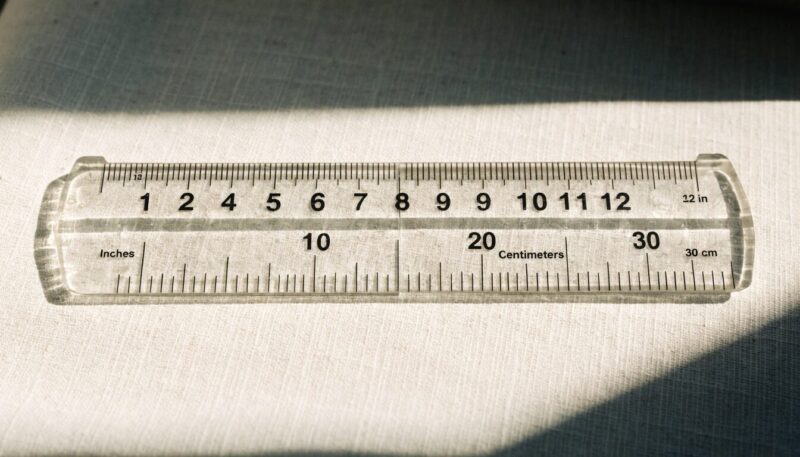

Quick answer: 12 inches equals 30.48 centimeters, 304.8 millimeters, exactly 1 foot, and 0.3048 meters.
Maybe you are measuring a piece of paper, a ruler, a shelf, or a school project, and you saw “12 inches” written down but you actually think in centimeters or meters. Or maybe a recipe, a craft pattern, or a homework problem gave you inches and asked for millimeters. Either way, converting 12 inches into other length units only takes a little multiplication, and this article walks you through every step. You will get the exact answer for each unit, a simple method you can reuse for any number of inches, plenty of real examples, and a free calculator so you can check any inch measurement instantly.
| Fact | Value |
| 12 inches in centimeters | 30.48 cm |
| 12 inches in millimeters | 304.8 mm |
| 12 inches in feet | 1 foot |
| 12 inches in meters | 0.3048 m |
| Formulas used | inches x 2.54 = cm; inches x 25.4 = mm; inches ÷ 12 = feet; inches x 0.0254 = m |
| Inches | Centimeters | Millimeters | Feet | Meters |
| 1 inch | 2.54 cm | 25.4 mm | 0.083 ft | 0.0254 m |
| 6 inches | 15.24 cm | 152.4 mm | 0.5 ft | 0.1524 m |
| 10 inches | 25.4 cm | 254 mm | 0.83 ft | 0.254 m |
| 12 inches | 30.48 cm | 304.8 mm | 1 ft | 0.3048 m |
| 24 inches | 60.96 cm | 609.6 mm | 2 ft | 0.6096 m |
| 36 inches | 91.44 cm | 914.4 mm | 3 ft | 0.9144 m |
| 39.37 inches | 100 cm | 1,000 mm | 3.28 ft | 1 m |
Inches to CM, MM, Feet & Meters Calculator
12 in = 30.48 cm | 304.8 mm | 1 ft | 0.3048 m
How many centimeters is 12 inches?
12 inches equals 30.48 centimeters. You find this by multiplying 12 by 2.54, since every single inch equals exactly 2.54 centimeters.
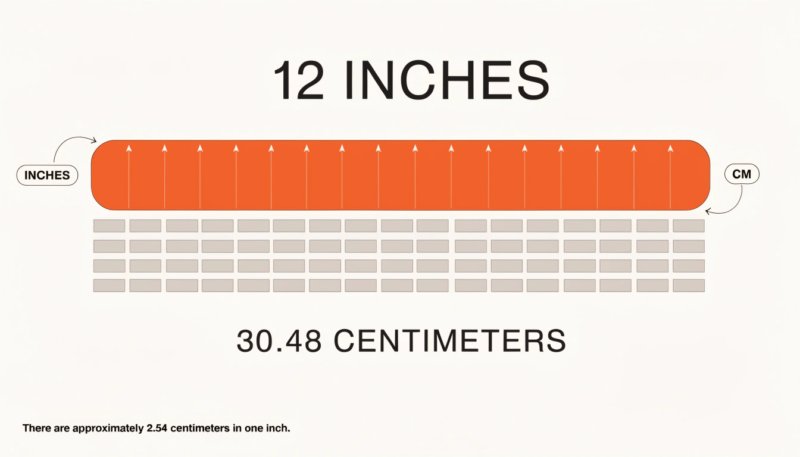
The number 2.54 is not a rounded estimate, it is the official, exact definition of an inch in the metric system. That means 12 x 2.54 gives you a precise answer, not an approximation: 30.48 centimeters exactly. You can picture this by imagining 12 rulers lined up end to end, each one exactly 2.54 centimeters wide, and adding all those widths together.
Knowing that 12 inches equals 30.48 centimeters is handy any time you are working with a ruler, a piece of paper, or a craft project that lists measurements in inches but you want to picture the size in centimeters instead.
How many millimeters is 12 inches?
12 inches equals 304.8 millimeters. You find this by multiplying 12 by 25.4, since one inch always equals exactly 25.4 millimeters.
Millimeters are just a smaller slice of a centimeter, with 10 millimeters fitting inside every 1 centimeter. Since you already know 12 inches equals 30.48 centimeters, you can also find millimeters by multiplying that number by 10, giving you the same answer, 304.8 millimeters. Both paths work because centimeters and millimeters are directly connected by a factor of 10, the same way dimes and pennies are both connected to dollars.
Millimeters are especially useful for very precise measurements, like the thickness of a phone screen protector or the width of a screw, where inches or even centimeters are too big of a unit to be useful.
How many feet is 12 inches?
12 inches equals exactly 1 foot. You find this by dividing 12 by 12, since a foot is defined as a group of exactly 12 inches.
This is one of the easiest conversions in the whole imperial measurement system because the numbers match perfectly. There is no rounding and no leftover remainder, 12 inches and 1 foot are simply two different names for the exact same length, just like a dozen eggs and 12 eggs are the same amount described two different ways.
This is why a standard ruler is 12 inches long, since rulers are usually built to measure exactly one foot, making it a handy, everyday example you can picture without any extra math.
How many meters is 12 inches?
12 inches equals 0.3048 meters. You find this by multiplying 12 by 0.0254, since one inch equals exactly 0.0254 meters.
An easier way to think about this is to start from the centimeters answer you already know. Since 12 inches equals 30.48 centimeters, and 100 centimeters make up 1 meter, you divide 30.48 by 100 to move the decimal point two places, which gives you 0.3048 meters. Because 12 inches is only 1 foot, and 1 meter is much longer than 1 foot, it makes sense that the meters answer is a small decimal number less than 1.
How do you convert inches to cm, mm, feet, and meters step by step?
You convert inches into the other units by using four simple operations: multiply by 2.54 for centimeters, multiply by 25.4 for millimeters, divide by 12 for feet, and multiply by 0.0254 for meters. Here is the full process broken into clear steps.
- Write down the number of inches you want to convert. Example: 12.
- To find centimeters, multiply by 2.54. Example: 12 x 2.54 = 30.48 cm.
- To find millimeters, multiply by 25.4, or multiply your centimeters answer by 10. Example: 12 x 25.4 = 304.8 mm.
- To find feet, divide by 12. Example: 12 ÷ 12 = 1 foot.
- To find meters, multiply by 0.0254, or divide your centimeters answer by 100. Example: 12 x 0.0254 = 0.3048 m.
- Double check your work by dividing your centimeters answer back by 2.54. You should land back on your original number of inches.
This six step method works for any number of inches, not just 12. Once you remember the two key numbers, 2.54 and 12, you can convert almost any length in your head or with simple multiplication.
What are some real examples of inch conversions?
Real examples make these conversions easier to picture, so here are several everyday lengths in inches and what they equal in other units.
- 1 inch is 2.54 cm and 25.4 mm, about the width of a large paperclip or a quarter coin.
- 6 inches is 15.24 cm and 0.5 feet, close to the length of a smartphone.
- 8.5 inches is 21.59 cm, the short side of a standard sheet of printer paper.
- 12 inches is 30.48 cm and exactly 1 foot, the length of a standard school ruler.
- 18 inches is 45.72 cm and 1.5 feet, about the length of a large kitchen cutting board.
- 24 inches is 60.96 cm and exactly 2 feet, roughly the height of a toddler's booster seat.
- 36 inches is 91.44 cm and exactly 3 feet, which is also called 1 yard.
- 39.37 inches is very close to 100 cm, or 1 full meter.
Notice how 12 inches sits at a special, round number in the imperial system since it equals exactly 1 foot, even though its metric equivalents, 30.48 cm and 0.3048 m, are not round numbers at all. That mismatch is exactly why converting between imperial and metric units usually needs a calculator or a chart instead of simple mental math.
What exactly are inches, centimeters, millimeters, feet, and meters?
Inches and feet belong to the imperial measurement system used mainly in the United States, while centimeters, millimeters, and meters belong to the metric system used in most other countries. Both systems measure the exact same thing, length, they just use different sized building blocks to do it.
In the imperial system, 12 inches always makes 1 foot, and 3 feet always makes 1 yard. In the metric system, 10 millimeters always makes 1 centimeter, and 100 centimeters always makes 1 meter. The metric system is easier to scale up or down because everything is built on groups of 10, while the imperial system uses different sized groups, like 12 and 3, for different units. The bridge between the two systems is the exact number 2.54, since that is how many centimeters fit inside every single inch, no matter which country you are in or which system you started with.
What mistakes do people make when converting inches to metric units?
The most common mistake is rounding 2.54 down to just 2.5, which seems like a small shortcut but adds up to a noticeable error on longer measurements. Always using the full 2.54 keeps your answer accurate.
A second common mistake is mixing up centimeters and millimeters, since the two units look similar but are 10 times apart in size. Writing "30.48 mm" instead of "30.48 cm" for 12 inches would be a length ten times too short, so it helps to double check which unit label you are using before finalizing an answer. A third mistake is forgetting that feet and inches use a different relationship, 12 instead of a power of 10, which trips people up when they try to apply metric-style thinking, like moving a decimal point, to the inches-to-feet conversion. Since 12 inches equals exactly 1 foot, remembering this one clean example can serve as an anchor point for checking other inch-to-feet conversions.
Why does the 12 inches to 1 foot conversion matter in everyday life?
The 12 inches to 1 foot conversion matters because rulers, tape measures, furniture dimensions, and building plans in the United States are almost always labeled using feet and inches together. Knowing that 12 inches always equals 1 foot lets you switch smoothly between the two without stopping to do extra math.
For example, a door might be listed as "6 feet 8 inches" tall, and knowing the 12-inch rule helps you understand that is the same as 80 total inches, since 6 x 12 is 72, plus 8 more is 80. Furniture shopping, home improvement projects, and even gym equipment often list height or length in a mix of feet and inches, so being comfortable converting 12 inches into 1 foot, and knowing how to convert that same 12 inches into centimeters or meters for anyone using the metric system, makes reading labels and following instructions much easier.
What is a simple chart comparing inches to centimeters?
The chart below shows how centimeters grow evenly as inches grow, using some common values people search for, with 12 inches highlighted.
6 in
15.2 cm
10 in
25.4 cm
12 in
30.5 cm
18 in
45.7 cm
Bar height shows centimeters for each inch value. 12 inches (green) equals 30.48 centimeters, or exactly 1 foot.
FAQ
Is 12 inches the same as 1 foot?
Yes, 12 inches is exactly the same length as 1 foot. There is no rounding involved, since a foot is defined as a group of 12 inches.
How do I convert 12 inches to centimeters without a calculator?
Multiply 12 by 2.54 by first doing 12 x 2.5, which is 30, then adding 12 x 0.04, which is 0.48, for a total of 30.48 centimeters.
What is 12 inches in feet and meters together?
12 inches is exactly 1 foot and 0.3048 meters. Both numbers describe the exact same length, just measured with different units.
Why is the centimeters answer not a round number?
The centimeters answer is not round because inches and centimeters come from two different measurement systems that do not line up evenly. The exact conversion factor, 2.54, produces a decimal answer for most whole numbers of inches.
Can I use the calculator on this page for numbers other than 12?
Yes, the calculator works for any number of inches you type in, not just 12. Enter your number and press Convert to see centimeters, millimeters, feet, and meters all at once.
References
- National Institute of Standards and Technology, "NIST Handbook 44: Units and Conversion Factors" (2024)
- Bureau International des Poids et Mesures, "SI Base Units: Meter" (2023)
- Khan Academy, "Converting Units of Length: Inches, Feet, and Metric Units" (2023)

A Teacher with 5 years of experience. Our Expertise, is reliable to meet your full Academic development needs . Worked on many crafts and construction projects offering services from design to development to deployment over the years. You will find many of my works in my business portfolio on request.